

Smoked Summer Air
- Matt Lucas

- Sep 11, 2025
- 22 min read

It’s mid August as I’m writing this and we’re currently in the middle of a “woods ban” in Nova Scotia due to the extremely dry conditions and lack of rain.There have been several wildfires that have broken out since the restrictions, so I certainly agree the situation is bad out there. As of August 5th, the provincial government has now made it illegal to enter the forest without proper permissions and have closed many of the parks and trails throughout the province. That means all hiking, fishing, camping, ATV use, etc. - all banned for the time being. Penalties for breaching the restriction order could result in a $25,000 fine. I have mixed feelings about this, but regardless, I’ve been keeping to the guidelines until the restrictions are relieved after a prolonged rainfall, or until October 15th. And despite the restrictions, I’ve still been able to get out to certain locations that aren’t under the restrictions, primarily beaches.

August 1 & 2
Beth and I had a trip planned to stay at one of the glomes at White Point Beach Resort, taking the number 3 highway for most of the drive there. It was truly a wonderful experience all around, stopping in Chester for a quick bite to eat and exploring the town a bit. We arrived at White Point near dinner time, checked into our glome that overlooked Doggetts Pond (which was filled with different birds), and of course the first thing I did was run out there and start snapping away. I counted close to 60 Short-billed Dowitchers perched along the rocks in the middle of the pond, with more flying in every minute. The first keeper image of the month was of a small group of them perched on one of the rocks, with a high key look to the overall photo.


We had a plan to visit the Kejimkujik National Seaside Park later in the morning, but I wanted to catch the White Point sunrise along the beach before heading off. The resort was filled with domesticated rabbits of different breeds, and they were scattered throughout the area. I wasn’t particularly interested in photographing the rabbits, but I was hoping, as horrible as it sounds, that something would be hunting them and that I would have the chance to capture that. Fortunately for the rabbits (an unfortunate for me) nothing seemed to be on the prowl within the resort grounds, so I headed towards the beach.

The rolling waves were backlit just as the sun was beginning to creep over the horizon. There were several seabirds along the beach, mostly gulls, one of which was a Great Black-backed Gull that I created a silhouette shot of with the golden glow reflecting off the water. There was also a large group of Common Terns that flew into the area. I spent the better part of the morning experimenting with different compositions as they darted around snatching prey and looping overhead.


I took some time before returning back to the glome to explore the grounds around the resort. I managed to photograph a Northern Parula for the first time all summer, and a juvenile Hermit Thrush, Song Sparrow, and Cedar Waxwing nearer to the golf course. I ended my photography outing at White Point with another venture down to Doggetts Pond, where I created an image of a group of Double-crested Cormorants lined up near the rocks where I photographed the dowitchers the day before. There was also a Great Blue Heron doing its thing closer to the edge of the pond. I was able to freeze the action as the heron launched its upper body into the water, unsuccessful, but graceful at the same time.


Beth and I packed up our things and took off for the long awaited hike around Kejimkujik National Seaside Park. The light was already getting flat with zero clouds in the sky. Most of the wildlife was sticking to the shadows, and I only managed to get dappled lighting shots of a Yellowthroat and Chestnut-sided Warbler along what I call “warbler alley”. An Alder Flycatcher was waiting for us near the beach as we approached and a large family group of Common Eiders hanging out on the seaweed covered rocks would be my last birds shots of the day. While the main subject for this outing was intended to be a black bear, we saw no signs of it. I knew it was a long shot given the time of day we were hiking around, and the ever increasing numbers of tourists and hikers entering the area.


A muted shot of a Grey Seal would be the last keeper image of the outing. I experimented with a wider crop and desaturating the photo. I don’t often take photos during the middle of the day, but I didn’t want to pass up on an opportunity to try something different given the unique pose of the seal and the action of the ocean spray behind it. I’m not sure that this image works overall, but I wanted to try something new and different.


August 6
The forest ban was now in effect, and there was a lot of confusion around what was off limits and what was accessible. The whole announcement felt very rushed and communication was less than stellar from our provincial government. I have my own opinions about the whole thing aside from what I just mentioned, but I don’t want this to be the place to voice them. I do agree that something had to be done to minimize the risk of wildfires given our current climate in Nova Scotia, but I’m unsure that this was the way to do it. Seemed more of a bandaid fix to me than anything else. While the wildfires that have happened and continue to happen here in Nova Scotia are truly horrible, and a massive shoutout to the emergency responders and volunteers working tirelessly to save people’s homes and the forests. I do hope that we as a province are willing to have larger discussions about forest management and longer term solutions for our environment because this shit suckkkkkkks.

I rescheduled all of my shoots planned in the forest for the month and changed most of them to cover predominantly beaches, as there are plenty of them in Nova Scotia. Beth and I did go to the Brookfield Wetland and Nature trail that day, not knowing the specifications regarding what is considered the “woods” at the time, which I guess includes bogs and muskegs. Wetlands seem to have a variety of classifications so it is all very confusing. I reached out to the DNR for clarification, but I never received a response assuming they have bigger issues to deal with at this moment.
Stepping out of the car we were greeted by an American Robin perched along the wooden guardrail in the parking lot. There were also several Ruby-throated Hummingbirds buzzing around the trail of which I managed to capture one perched on a branch. The low light reflected off the glistening feathers of the hummingbird was gorgeous. I only wished I was able to photograph a male, as I don’t think I have any shots of them currently.

We ran into a couple of people with cameras doing some bird photography as well. The more experienced birder pointed out a pair of juvenile Hooded Mergansers in the pond, along with a female Ring-necked Duck. I lowered myself near the pond's edge to get some eye-level shots of the waterfowl.


After watching a Northern Harrier do a quick flyby, the one of the photographers mentioned to us about an American Bittern that had been showing up at the trail around 8 PM each evening. The American Bittern was high on my viewing list as it’s been a species of bird I’ve been wanting to see since my grandmother gifted me the 90’s something National Geographic bird watching book when I was a wee lad. And she was pretty spot on with the timing. Here comes this American Bittern, flying in as the sun was getting low, into a massive patch of grass in the pond. I could only make out the top of the head peeking out from the grass below, but I finally managed to get my first images of this majestic bird.


I just finished taking some bird’s-eye view shots of a Green Frog from a bridge when I spotted another unexpected visitor to the pond. A Common Nighthawk was darting in the skies above. It even made a low pass along the trail, nearly flying into Beth as we made our way back to the car.

August 7
A location I’ve been eyeing for a few months now was Houston’s Beach located in Kings County. The main subject for this shoot was to photograph the Bank Swallows that nested along the sandstone cliffs along the Minas Basin. While I was a couple weeks late on the prime breeding season for the swallows, I did see a couple flying around in the overcast skies above. I managed to get a shot of one flying over the ledge of a cliff with long stalks of grass slowly eroding towards the edge.
While I was focusing on the swallows a commotion began behind me. I turned to see the Ring-billed Gulls that were once feeding near the edge of the beach suddenly scatter as a Peregrine Falcon entered the area. I’m not sure if the falcon actually made an attempt to hunt the gulls, but it didn’t seem interested in hanging around after the gulls left.

I started heading back to the car as the sun was going down. I parked about half down the road from the beach because I wanted to see if any wildlife would pop out. There was a farmfield to my right and a tidal marsh to my left. I made it to the stop sign at the end of the road and as I turned back I saw a little blorb on the farmfield side. I got my lens up to get a closer look and it turned out to be an American Woodcock. I lowered myself onto the ground and crawled ever so slowly towards the subject. I had to lower my shutter speed to accommodate for the lack of light and shot away. I think I took over 70 shots of the American Woodcock, and only managed to walk away with less than 10 keeper shots. My favourite part of the final edit shot is the purple hue that is cast over the landscape as whatever light was left above the horizon shone through the thin layer of cloud.


August 9
Next beach on my list for the month was to visit Conrad’s Beach in Lawrencetown. I was hoping to get some early morning shorebird action and I ended up finding a small group feeding amongst the seaweed towards the end of the right side of the beach, just before the rocks. Unfortunately for me, it didn’t take long for other people to show up, mostly with their dogs (unleashed) and scare everything off from the beach for me. So that was annoying, but the show must go on and I decided to walk along one of the trails that went through the beach grass to the other beach to see if I would have better luck there.

It was already a couple hours after sunrise but there was so much haze in the air from the smoke due to the wildfires that it completely diffused the light from the sun. The sun just looked like an orange fireball slowly rising in the sky. After experimenting with some landscape shots incorporating the diffused sun I ran into a Savannah Sparrow perched in a spruce tree and I thought it was the perfect time to try and line up the sun behind it. I wished the perch it was on was a little more interesting, but I was well happy that I managed to get what I got.
The diffused light lingered for another hour or so and I tried several different landscape compositions with the beautiful orange glow from the sun bathing the ground. The reflecting light off the sand as the waves rolled in made for some of my favourite shots of the day, and a landscape image of the incoming waves, with a few stones used as a foreground element and the Lawrencetown Cafe on a hill in the background was another favourite. There was a small pool near the end of the beach with some dead tree trunks near the edge. That also made for some unique and moody landscape shots.


Walking back from the second beach I ran into a different species of butterfly I hadn’t run into before called a Common Wood-Nymph. I took a shot of one that landed on one of the purple thistles as the sun began to rise above the haze. I made it back to the boardwalk and there were plenty of people showing up to the beach at this point. I saw the end where the shorebirds were pretty clear of people so I thought I’d give it one more go to see what I could see.
There were several Barn Swallows flying low along the beach. I did my best to try and capture one, but the autofocus was not cooperating with me as it was difficult to hone in on the subject while there were so many things for the focus point to lock in on. Not long after the swallows is when I ran into the small group of shorebirds again. Three Sanderlings were just taking off to escape an incoming wave and that is the only keeper shot of the shorebirds I liked enough to edit. I took plenty of other photographs of the other species, but I wasn’t a huge fan of the compositions and figured I would have plenty more chances throughout the month to improve my shorebird techniques.


The last keeper image of the morning was of a Nelson’s Sparrow belting out a song on the boardwalk. I tried lining up the railings and other wooden siding to create leading lines directing the viewer’s eyes to the subject. I only had a couple minutes to try this technique before another dog without a leash spooked it off. If you couldn’t tell, I might harbour some ill-will towards dog owners that keep their dogs off leash.
August 10
The next beach on the list was Clam Harbour. I was a little more hopeful that this beach would be less populated by people, and it was for the most part, and whatever dogs were off leash were soon handled by their owners and put back on again. This pleased me.


It took a little while for the action to pick up but once it did it was shorebird mania. First on the docket was a Spotted Sandpiper perched on some sharp rocks just off shore. I went for a high key edit with the final edit for this subject, something I’ve done before with Spotted Sandpipers. Another high key image I took not long after was of a Black Guillemot. I liked the minimal look to the image with the subject tiny in frame. If it wasn’t in its breeding colours I don’t think this shot would’ve worked. There was also a male American Goldfinch feeding near the rocks of the shore that I took decent images of too.

Other keeper images of shorebirds include Semipalmated Sandpipers, one of which I centered in the frame and the viewer can get a good look at the back plumage. A couple of White-rumped Sandpipers joined the party and I got a few shots of those too. The shorebird keeper was a Semipalmated Plover, by far the most abundant subject at the beach. I created an image of a plover with a wave just beginning to break behind it, creating some bokeh balls in the background.
There were also some songbirds in the area that I was able to photograph too. Though I wasn’t allowed to enter the woods at all, I did stop a few times driving out of the park to capture whatever was hanging out on either side of the road. There were several Yellow-rumped Warblers feeding in the area, and an unexpected Palm Warbler also showed up for the shoot.


August 14/15
I had a weekend planned in Mactaquac, New Brunswick, with my friends, but I wanted to spend the night outside Sackville, which is near the border of Nova Scotia and New Brunswick. The original plan was to camp just outside the town, but New Brunswick also had a woods ban, which meant no camping, so I opted to sleep in the car instead. The area I wanted to photograph was the Tintamarre National Wildlife Area, which is a mix of farmland and wetland, or at least the area that I was sticking to.

I got there a couple hours before sundown, which gave me just enough time to get a few kilometres in. A Snowshoe Hare was feeding along the path as I started the trek. It started to downpour not long after getting there, and I was forced to wait under a tree for the rain to stop. It lasted 15 minutes or so before the clouds began to clear, after which I took some landscape shots with the unique cloud cover and colours. A Swamp Sparrow would be the only bird shot for that evening.

The clouds began to darken again so I thought it best to get back in the car and it’s a good thing I did. It was an hour or so after I left that a lightning storm rolled through. The storm lasted at least an hour, if not more, with flashes and strikes happening every 10 seconds on average. One strike was so close to me that I could hear the air cooking as the bolt hit the ground. It was a nerve wracking night, but I eventually got to sleep.
I returned the following morning for a sunrise shoot and it was a significantly more bountiful session than the night before. I watched a Northern Harrier hunting in a field to my left and watched it glide its way over to the wooden fencing nearby. I’ve been wanting to get more images of birds of prey on perches, particularly wooden perches. There’s something about that composition that I love. A lot of it has to do with the background colours of a field, and the eye-level perspective that you wouldn’t get if the bird was perched in a tree. I must’ve taken close to a thousand shots of this harrier as I inched closer and closer to it, plus the low light at the time necessitated the need for a butt-load of exposures. The image that made the final edit shows off the browns, greens and yellows of the environment, particularly the wild flowers growing alongside the path.


A Killdeer made a couple passes as I made my way down the road, making several loops before landing back at one of the nearly dried up ponds. I managed to get a few shots of it in flight, with a less than ideal background. Not long after taking a few shots of the Killdeer did I hear the familiar, yet unexpected hoots of a Sandhill Crane. And it wasn’t just one Sandhill Crane, but three! The three large birds flew in from the north and made their way across the farmland and ponds, basked in morning light. They continued to fly further into the wetland area, beyond the sight of my lens, but I think the images I created of them were some of my favorites of the morning.

Other honourable subject mentions of the morning were a Savannah Sparrow perched on a concrete divider near a bridge, another unexpected visit from a Canada Jay far off in a young spruce, and a group of Bobolinks, mostly female, moving from flower patch to flower patch.


August 16
I didn’t go out this weekend for any proper photoshoot, but there was a group of American Black Ducks that would hang around our boat fairly often. Presumably they were used to being fed by other people who rented out the houseboats and didn’t venture too far from the area. The mist was low on this particular morning so I lowered myself onto the ground of the front of the boat to try and get some images of the ducks in the fog. I wish the ducks were facing the other way and it’s kind of hard to make out the exact details, but I felt that the photo I selected for the final edit was worth posting here.

August 20
Beth and I ventured to South Maitland, specifically the Fundy Tidal Interpretive Centre, for a quick evening shoot. Given that the woods ban was still in effect, we didn’t want to venture too far along the paths behind the centre, and instead opted to hangout near the parking lot for most of the photography. We only spent an hour or so here, but it was well worth it for some of the images I got.


I created some images of a Cedar Waxwing and Common Yellowthroat, which were common in the area, but by far my favourite image out the outing was of a Greater Yellowlegs preening itself in a nearly dried up pond. I got a beautiful, clear reflection of the yellowlegs with the late summer greens and yellows adding a punch of colour to the image. There were hundreds of water insects moving around in the pond and the highlights from their movement made the insects look like wide stars in the background.

August 23/24
Our plan for this weekend was to head to Fox Island Main, located in Guysborough county, to celebrate Beth’s friend’s birthday. Beth booked us another dome campsite at Seabreeze campground, which was located along the beach. We arrived late Friday evening to meet up with Beth and her friends, but it wasn’t until the morning that the photography started.
I didn’t get up for the sunrise, but I did get up for a quick walk along the beach later in the morning to scout out the area. The sunlight was harsh by this point but there was a large shale-like boulder along the shoreline on the left side of the beach. Hurricane Erin had just passed through off the coast of Nova Scotia, but some of the strong waves remained. I tried incorporating some of the wave action, along with the sheen off the wet rocks. With these elements, along with the harsh lighting conditions, I focused on creating some contrasty macro landscape shots of the coastline.


Later in the day, we went to Queensport to board Beth’s friend’s sister’s fishing boat during a mackerel derby. The plan was to board the boat as they were waiting for the results of the derby and make our way back to Canso for dinner time. A few people had done the same trip the day prior and mentioned that there were a couple of whale and dolphin sightings, so I was eager to join the crew. We were in a bit of a rush heading back, as meteorologists were predicting strong winds as the evening drew near. While we did spend a bit of time on the water, we couldn’t see anything aside from the odd grey seal, cormorant or gull. I did create a couple compositions of the few things I did see as we drew closer to Canso. A lone Double-crested Cormorant on a wooden support beam in the middle of the harbour was the first shot, followed by a couple of images of an American Crow and European Starlings perched on some rusted commercial netting equipment stacked along the pier.


Heading back to our campsite, I created one last image of the day of the setting sun moments before it dipped below the horizon.

I got up early the following morning to catch the sunrise, though admittedly I was a little late. I still managed to get the sun being bisected by a cloud, which made for a unique sunrise composition. A group of Common Eiders were feeding fairly close to the shoreline and I was able to get into a position on the beach where I could lay down and wait for them to paddle by without disturbing them too much. My experience with these birds has taught me that they’re extremely skittish, so I was surprised these ones were hanging out so close to the water’s edge as this group was.

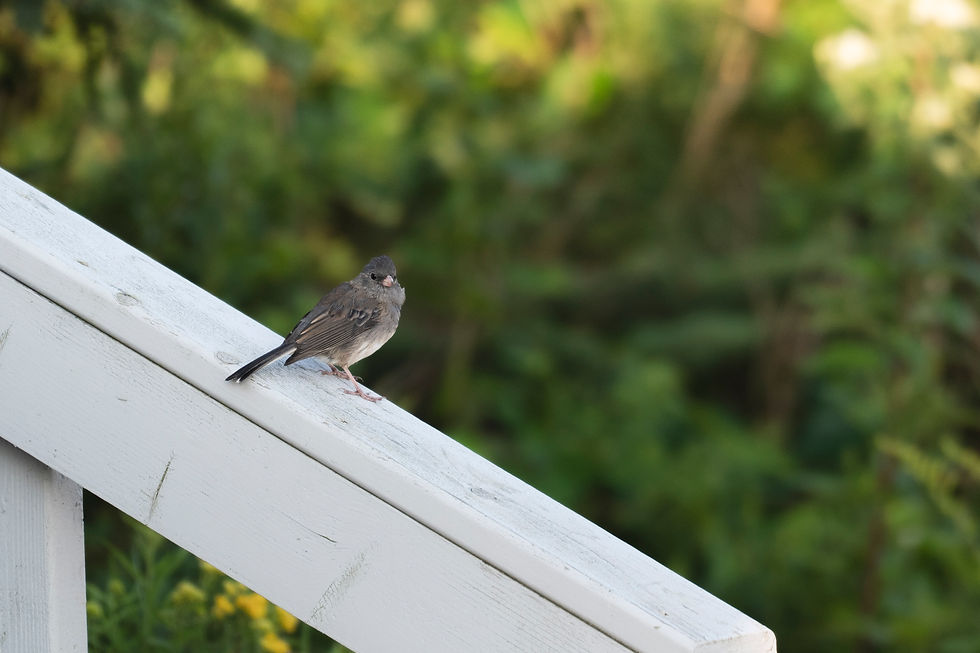
A few Dark-eyed Juncos would be the last species of bird that I would photograph in this area. They were hanging out near the steps that led to the beach area. I managed to get one with browner colouration perched along the railing of the stairs.

The last shot I selected for a final edit was of a Snowshoe Hare that we found as we were dropping off the keys in the dropbox. There was actually a pair of them in the parking lot hanging out underneath an SUV. One of them popped out long enough for me to get a shot of and Beth was kind enough to roll down her window and allow me to raise the massive lens in front of her face to get this mediocre photo.
August 28
I visited the Silver Sands Beach located in Cow Bay right after work. The sun was blazing in the sky with not a cloud in sight. Probably the least favourable shooting conditions I could’ve asked for, but I was determined to walk away with something before the night fell. I did one lap up and down the beach, seeing the odd shorebird and gull, but no compositions were speaking to me.

I spotted a couple of Black-bellied Plovers early on during the shoot, but they weren’t in an area I could get to to take decent shots of. I vowed I would come back to that spot once the sun got lower and try my shot at capturing them in better light, and that’s exactly what I did.
The two plovers moved to the shoreline of Cow Bay Lake, located behind the beach. The two birds would perform quick loops in the air, and make their way back to this one spot along the shoreline. They would then run into the tall grass, run back out, and perform the loop again. I’ve never seen this kind of behaviour before and am stumped as to what this behaviour was. It kind of looked like some sort of mating display, but this species' mating season typically ends in late July so it wasn’t that. At any rate, I created an image of one of the plovers moments before it ran into the grass, using some of the patches of grass closer to me as a foreground element.
August 30
I was very excited for this outing as it was the long awaited visit to Grand Pré to see some of the shorebird migration. This was one of my favourite wildlife experiences in the previous year and I’m glad I got to experience it with Beth. Admittedly, I was a couple weeks late in planning this shoot and we missed the bulk of the massive amounts of shorebirds that would show up to this area. That being said, there were still several ebird reports from the area showing at least a couple thousand Semipalmated Sandpipers hanging around and that was good enough for me.

Beth and I bounced between a few locations in the area to maximize our chances of seeing the most birds. We started at the Guzzle, but the rocks at the base of the dykes were filled with fishermen, which was pretty annoying. We then moved to the Evangeline Beach to see if we would have better luck there, and we did. I estimated about 850 Semipalmated Sandpipers were feeding and roosting along the rocks, with several other species of shorebird. One of the other species was the Least Sandpiper. A lone Least Sandpiper hopped onto one of the rocks and I was able to get a shot of it looking out to the horizon as its cousins were feeding in the sands below.
Beth and I switched locations again and moved to Penny Beach in Avonport. Again, the beach was littered with fishermen so we didn’t stay long, but we did see a massive murmuration of shorebirds, mostly Semipalmated Sandpipers, fly back towards Grand Pré. Beth and I looked at one another, shrugged, and decided to head back to Grand Pré with all haste.

As we were arriving back to the Guzzle, we could see the large, dark bands of heavy rain scattered throughout the dykeland. I was awestruck to witness this weather. One part of the fields would be washed in golden light from the setting sun, and a field directly beside it would be washed with rain, literally. While the flock of sandpipers moved on, likely due to a Peregrine Falcon sighted in the area, I instead focused my attention on the American Herring Gulls standing along the beach. A rainbow broke through the clouds as a large group of swallows entered the area. I lowered myself onto the sand and singled out a third year (I think) American Herring Gull and lined up the composition so that the end of the rainbow rested just behind the subject.

August 31
I wanted to come back to Grand Pré to film some of the shorebird action. I arrived at the Guzzle just before sunrise, but there were already a bunch of cars parked. I originally thought that the other cars were for people watching the shorebirds, but as I climbed the dykeland edge I saw loads of fishermen along the same beach where I took the photos of the American herring gull the night before. Thankfully, there weren’t any fishermen along the rocks where the shorebirds would typically be roosting during high tide, but there was another disturbance from the air...


A large flock flew in from the Avonport area towards the Guzzle, but were interrupted by a Peregrine Falcon on the hunt. This is exactly what I came for. Since seeing the video of Simon d'Entremont in Grand Pré filming the Peregrine Falcons hunting the Semipalmated Sandpipers on the wing, I’ve wanted to capture the exact same. While the falcon was pushing the sandpipers further out into the basin I still managed to get some of the action as it was happening. Even though these aren’t the best quality photos, the fact that I was even able to witness this behaviour was amazing enough. The falcon wasn’t successful, this time around anyway, and flew towards the shore to find easier prey. I would see the Peregrine Falcon at least another three times during this shoot, flying back and forth between beaches in the area.


Something you’ll notice about the Peregrine Falcon is that there is a low “fog” hanging around the farmland. I actually received an air quality warning within Kings county just before arriving. This was due to the smoke that was blowing from the Long Lake wildfire that’s been going on since August 13th. My guess is that the rain we received the day before was causing an excess of smoke and the smoke was making its way eastward, hanging low in the area from the lack of wind. While I know it wasn’t the greatest idea to hang around and breathe the stuff in as I walked around with my camera, I was certainly not going to pass up the opportunity to photograph wildlife in these unique conditions.

Some of the shots I created during this time were of a pair of Northern Harriers somehow managing to hunt through the haze - a male on the wing, and a female taking a quick breather in a field. A Ring-necked Pheasant taking flight and moving from one field to another, a House Sparrow perched on top of a sign warning pedestrians of tractors in the area, a small group of Barn Swallows that were perched on top of a nearby barn (what strange to find them lol). There was also a Common Yellowthroat that peeked out from the cornfield that I created shot with it staring directly at me.


I walked along the road that would take me to the Evangeline Beach in hopes that I would see more sandpiper action there. Along the way I encountered a Gray Catbird and Yellow Warbler hanging out in the dense bush off to the side of the dirt road. I created individual shots of both of these birds just peeking out from the bush to see what was going on.


As I neared the beach, I walked through a high action scene where several different species of bird appeared. Some of the ones I managed to get decent shots of were a Rose-breasted Grosbeak, a Black-throated Green Warbler, a Black-and-White Warbler, and a Downy Woodpecker. I also had a surprise encounter with a Northern Mockingbird that was perched on some wooden fencing next to the parking lot by the beach. It posed in a number of different ways, giving me all kinds of angles to play with, but the one I liked the most was the shot of the mockingbird giving me the side-eye with the colours of the Canadian flag in the background.


My last keeper shot of the month was of a Common Raven. I took this shot as I was returning to my car near the Guzzle. The heat haze messed with the sharpness of the photo, but I used a wider crop in the final edit so as to help mitigate that issue.

Summers can be a weird time for photography. On one hand, wildlife can be abundant if you’re at the right spot at the right time. On the other hand, wildlife can be a lot more difficult to see if the wildlife is sticking to the thick bush and tree canopies. Add on the temporary woods ban throughout all of Nova Scotia and it made for some challenging shooting conditions. All that is to say that I still managed to get a decent amount of shots throughout the month and even witnessed some amazing wildlife scenes. Something I will say for this month is that it offered a number of unique shooting conditions. The wildfires that happened throughout the province, particularly the Long Lake fire, is awful - no question. As I’m writing this, the Long Lake wildfire has been stabilized, but still not fully under control. Some people are able to return to their homes, and that is all thanks to the firefighters and volunteers who selflessly risked their lives and time to minimize the damage caused. In the significantly small chance that any of these people are reading this - thank you!


Comments