

That Beautiful Ice
- Matt Lucas

- Feb 9
- 14 min read

December wasn’t the abundant nature photography month that I was hoping it would be and I was feeling a bit down about it. Even reviewing the photography I did manage to take I was finding the compositions to be a bit lackluster and uninspiring. Of course this wouldn’t be the first time I’ve felt uninspired by my photography, and likely won’t be the last, but I don’t find I usually feel this way towards the end of November and during the winter months. Life is not as abundant during the winter months for obvious reasons, but I still make the effort to get out and shoot as much as I would during the spring and summer months, so long as the daylight allows. As I’m writing the intro to this blog I’ve already logged in a handful of shoots, some more productive than others. My hope is that my luck will turn for the rest of the month and that the locations I choose are more productive than I’ve experienced in previous years.

January 3
First nature shoot of the year and I chose to go to a location that I’ve always lived close to, but have never ventured there until today - the Sackville Lake trails, particularly the trail that runs along First Lake. It was a brisk morning with clear skies with the lake mostly frozen over from the cold. Things started off very strong with an early sighting of a Barred Owl with a headless rat in its talons. The sun was only just starting to rise above the horizon so the shutter speed was low at first, shooting around 1/30th of a second. Thankfully, the owl remained in the same spot for several minutes and well past sunrise, allowing me to continuously raise the shutter speed as more light entered the space. I may have taken nearly 600 photos of the owl alone before it would take off suddenly, heading deeper into the woods. Great start to the day.


The shoot would quiet down quite a bit after the encounter with the owl, but I would create a couple more keeper shots before the morning was through. A few Golden-crowned Kinglets were feeding along the ground near the edge of the trail, super close to where I was standing. I don’t often see kinglets so close and on the ground so I did my best to capitalize on the situation while it lasted. I settled on a shot of one on a bed of leaves with the cooler tones of winter painting the overall image.
The last keeper shot of the morning was of a Brown Creeper climbing up a dead tree with most of the bark stripped away. The sun was blasting it from the opposite side of where I and the bird were positioned. I would need to raise the shadows in post processing of the Brown Creeper and the tree itself to highlight some of the details of the scene.

January 4
I was very excited for this outing as it took place in one of my favourite environments to shoot in, open fields and marshes. The landscape was similar to that of Kings county, particularly around the Grand Pré area, and I’ve been very vocal about how much I love shooting up that way, especially during the winter months. I had been scouting a couple areas, not in person but on Google Maps, and found a DucksUnlimited conservation area just outside the town of Amherst. A couple of recent ebird reports in the area would be the final push I needed to set an early alarm, drive 2 hours, and brave the -20 C weather to hopefully find a couple of unique species of bird that would be lifers for me: the Rough-legged Hawk and the Redpoll.
The hawks were nowhere to be seen, but I would eventually run into the Redpolls - over 150 in fact. I headed into one of the nearby marshes and walked the snow covered trail that looped around the area. A massive flock of Redpolls came flying into the scene, most landing in a nearby tree and taking turns flying to the ground or nearby shrubs to search for seeds. I created several keeper shots of the species, experimenting with a variety of compositions showcasing the environment these birds find themselves in.


There was also a small group of American Tree Sparrows feeding on some grass seed near the entrance to the marsh. These might be my favourite shots of the outing, and possibly even of this species that I’ve taken so far. A few shots consist of a pair of sparrows in flight as one leaves a perch and another takes its place. There is a nice mixture of compositions here and it was fairly easy to get a clean background with the open space around me. It was late morning when these shots were taken and the sun was bright and harsh. It was a nice change to shoot in a condition I typically don’t shoot in, and made for good practice when trying to balance exposure compensation and the brightness of the sun reflecting off the white snow.


The only other wildlife keeper shot of the day was of a large group of Common Eiders flying overhead, something I’ve never seen before. I wish there were some dynamics to the sky, like partial cloud cover instead of a completely blue sky. I think what saved this image was the position of the flight formation, being a unique line that takes up the whole length of the frame. I would come across a pair of Pine Grosbeaks, a species of bird I hadn’t seen since my last trip to Newfoundland, but they were so high up in the treetops that I only managed to get doc shots of them.
I would also experiment with some shots of the water rushing from the marsh into a drain. Unique ice structures were forming on either side, and the sand and dirt would add a pop of colour to the ice. It kind of reminded me of my trip to Soley Cove with Beth last January where we found large ice formations along the sandstone cliffside.


January 10
Beth and I stayed at her sister’s place near Barneys River Station and I always like to bring my camera there just in case I get the chance to get out for some nature photography. The area is a hotspot for wildlife and I have been fortunate before to have even come across a Bobcat, my first ever in the wild. I got up first thing to try my luck again.
There was significantly more snow in the area than compared to Halifax, where most of it had already melted from a warm spell. While there was a lot of snow still left on the ground, the warm spell did cause the roads that were already icy to become even more icy, so much so that I had to shuffle my way to the trail. I ventured down an old logging trail that ran beside a river, spotting several different tracks in the snow as I made my way. There were definitely bobcats in the area, along with coyotes, deer, grouse, hare, and even otter tracks. I wouldn’t find any of these species and aside from the odd chickadee or crow there was barely a bird to be seen. The only keeper shot from this outing would be of a Black-capped Chickee. It was taken just before walking up the stairs to get back into Beth’s sister’s house.


January 11
I made a rule for myself that I wouldn't travel to do photography during the freezing rain, but with all the Snowy Owl buzz happening along the shorelines of Nova Scotia I decided to risk it and head towards Crystal Crescent Beach to see how my luck would turn out. The roads weren’t that bad and I didn’t have any trouble arriving at the park.
I may have complained about this before, but doing photography with glasses in the rain is not ideal. And with the wind blowing sideways if I was standing in the wrong direction I was getting a face full of sleet. The only images I walked away with were of a Common Raven flying low over a mound of seaweed piled up along the beach.
January 14 & 15
Since the weekend wasn’t as productive as I was hoping it would turn out to be, I shifted my focus to practicing at the local cemetery (as one does). I knew there was a good chance of seeing something, as I often do, but another reason was to capture wildlife in the elements, which I find yields some of my favourite results.


For the first outing at this location for the week I only managed to photograph the Red-tailed Hawk that frequents the area. I tried something different as I approached the hawk from what I usually do. Instead of approaching it from the side, I changed routes and headed straight for it, under a small canopy of spruce trees. The red-tail actually flew into the tree it usually perches in just before I got there, and I snagged some shots of it landing in the busy branches. It wouldn’t stay there long as the hawk would soon be harassed by the crows and blue jays and decided to take off. It flew directly in my direction, making slow circles in the air before passing me. The final edit shot shows one of the only moments I felt truly seen by a hawk in the air, with the red-tail glaring down at me before continuing on.

The following day would be even more productive in the cold rain. Most of the birds out during the time I was at the cemetery were the numerous Song Sparrows. I tried my best to avoid taking nearly identical compositions of this species in the rain back in November, but to be honest, I think I like the shots from November more.
Another couple species I did take great shots of were the American Goldfinch and Northern Cardinal. The American Goldfinch was famed nicely inside a box of thorn branches with raindrops catching the highlights. With the subject being backlit to the best of my abilities given the conditions, the light also created a nice bright rim around the goldfinch.
A female Northern Cardinal would be the last subject of the outing. She too was framed nicely between the wet foliage, but the image is overall less busy than that of the American Goldfinch. I also like the colour pallet of the reddish browns and greens of the whole image and the subject blends so well with it.

January 17
I returned to Truro to finish the rest of the trails I didn’t get to last time I was there. And while I did see a few unique species like Pine Grosbeak, Evening Grosbeak and a Belted Kingfisher I wouldn’t get any keeper shots of them. I would get a couple of keeper shots of a Hairy Woodpecker, the second I would come across that day, and a female Northern Harrier flying over a field south of the North River.


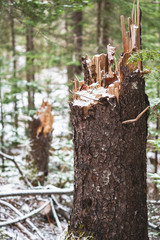
Something I tried to be mindful of was taking shots of everything that caught my eye, which for me usually means little nature vignettes. There had been a light snow that happened in the area the night before and the morning remained cold enough that it remained on the ground and limbs of trees for the duration of my time there. Along with several winter ice compositions, I would create many of these small landscape scenes before coming home.




January 18
Hartlen Point has been popping off these past couple weeks, particularly with a couple of species of owl being seen recently in the area. Another Snowy Owl that seemed to be reliably found there and a more recent visitor, a Short-eared Owl. Seeing both owls in the same spot would be a massive win for me, but I also tried my best to humble my expectations before starting my adventure.

My birding instincts were telling me to start off at the golf course instead of the main trail that leads to the beach and that’s exactly what I did. It turns out my instincts were completely off and aside from a few Golden-crowned Kinglets hanging out in the treetops, the only keeper shot I walked away with was of an Iceland Gull flying westward as the sun rose above the horizon.
After doing a loop around the golf course I made my way along the Shore Road, hoping to spot something scanning the fields for prey. Again, the only thing flying around the area were gulls, but this

time I snagged a keeper shot of a Ring-billed Gull flying in the opposite direction of the Iceland Gull. Below the Ring-billed Gull were several diving and wading ducks feeding along the shoreline. I got my lens up to take doc shots of all the different species so I could log them in ebird later that day, but an opportunity would present itself to capture a species I rarely get to see, and whenever I do they’re wayyy out in the middle of a harbour or something like that. A Barrow’s Goldeneye was wading relatively close to the shoreline and I got down prone to try and create an image. I believe I shot the image at f8, but I think I should’ve opted for a thinner aperture like f11 or maybe even f16 to get a bit more detail in the wave crashing over a rock in the foreground.

While I was photographing the Barrow’s Goldeneye a small group of people had gathered near the edge of Hartlen Point, all of whom were pointing their scopes and lenses towards Devil’s Island. I hobbled my way over to find out what all the excitement was about, knowing in the back of my mind that it was probably one of the owl species folks were seeing in the previous weeks. Turns out that the Snowy Owl was hanging out on the beach on the island. I scanned my lens over the whole of the island’s visible coast, snapping away as I did. While I couldn’t make any real detail of what was on the island’s shoreline, I did see what I thought to be a mostly white blorb with two teeny tiny black specs for eyes. Reviewing the images in Lightroom later I would end up having to zoom in over 200% to see the Snowy Owl, but at least I technically can say I saw it. I debated to return to Hartlen Point in the following days to try and improve the shots I had, but seeing the amount of reports being made on ebird I was worried about how stressed out the owl was becoming. I know some owls are highly sensitive to human presence, the Snowy Owl being one of them so I decided to take the documentation shots as a mild win and opted to return to Hartlen Point at a later point in time.

January 20/27
Much like the previous couple weeks, I decided to take my camera into work on several occasions to try and capitalize on all the bird activity that’s been happening there lately. I usually wait for some kind of weather to be happening, like flurries or even proper dumping of snow, but I have been making exceptions if something unique catches my eye.

On the 20th I wanted to focus on finding birds of prey, and if nothing came up then hopefully spot a White-throated Sparrow as that’s another common bird species there that is my favourite species of sparrow to photograph. I didn’t see any birds of prey, but would come across a couple of the sparrows. Typical for this species they were feeding from the ground under the dense canopies of the thornbushes above them. The keeper image I settled on of this species is admittedly not my favourite shot of the species, but I’m currently trying to experiment with taking messier/busier images to see what I can get away with during the editing process. Most of the time it doesn’t work, but life is messy and I would imagine wildlife is the messiest, so why not show that in my work.

On the day of the 27th the light was particularly harsh, especially since we just had some fresh snowfall the night before, which amplified the brightness of the light once the clouds parted. I returned to the same location in the cemetery that I have been going to for some time now, knowing it to be a reliable spot to find several different species of bird all in one little space. This time I heard an unfamiliar call of a bird that flew in from deeper within the cemetery and I whipped out Merlin to try and confirm what it was. Turns out I wouldn’t need the app as the Red-bellied Woodpecker would land in a tree only a few metres from where I was standing.
I found this species for the first time last year in the exact same spot where it was now (but in February, instead of January). All my attention went to the woodpecker and I snapped away the whole time it hung out in the area. It would eventually fly off to another spot in the cemetery, being very vocal the whole time. The keeper shot I settled on has amazing lighting, despite the harshness of the lighting conditions. I’m not entirely sure how this happened unless there was a slight break from direct sunlight at the time. I love the highlights in the eyes of the woodpecker - I think it’s my favourite aspect of the image. I’ve also been consistently shooting at f8 whenever the conditions allow it and I’m already blown away by the difference of sharpness compared to shooting wide open.

January 31
The last nature outing of the month took me to Conrad’s Beach in Lawrencetown. I felt I haven’t been capitalizing on the influx of waterfowl that graces our province during the winter months so I wanted to make ducks my focus for this outing. A good portion of the saltmarsh that lies behind the beach was frozen over, save for a small part on either side of the pedestrian bridge heading onto the boardwalk. And while I would see several different waterfowl species, the only ones I managed to get decent shots of were a small group of Northern Pintails. Thankfully they were tolerant of my presence and let me hunker down along the shore to snag some shots of them in the pinks and oranges of the dawn colours. While we usually get Northern Pintails in Nova Scotia during the winter, I don’t often see them so close to shore. This species has a special place in my heart as it was one of my favourite birds to see while I lived in Newfoundland. There is a park there that the Northern Pintails frequent all year round, making them much more tolerant of human presence than their Nova Scotia cousins seemingly.

Shortly after my time with the Northern Pintails came a lone Snow Bunting that landed in a patch of beach grass on the opposite side of the bridge. I slowly made my way over, taking extra caution as I walked across the frozen saltmarsh. Once I felt I was on solid ground I lowered myself to get eye-level with the bird. I took several different variations of compositions of this species and ended up settling on a wider angle shot showcasing more of the environment, along with the oranges of the rising sun.

Instead of walking along the beach, where several people had their dogs off leash, I chose instead to cut through the wooded area to get to the end of the beach. While I would encounter a couple more off leash dogs (annoyingly), that didn’t stop the wildlife from appearing, not completely anyway. I would see my first Snowshoed Hare since late August of 2025, which seems crazy to me. It bolted across the path I was on several metres away from me. I tried my best to find it again, but since the hare was in its winter white coat it was nearly impossible to find. I was gladdened to see the amount of hare tracks there were throughout the wooded area. It gave me hope that the species was rebounding from the previous year’s low hare count. The only keeper shots I managed to get were of a Golden-crowned Kinglet feeding in the spruce trees, and a male Northern Harrier near the end of the beach. There were actually a couple of Northern Harriers that were perched amongst the foliage of a fallen spruce tree.


The busiest time for photography during this shoot was when I got back to my car. There’s a property on the hill just next to the parking lot that seems to be a small hotspot for bird activity. I would walk away with keeper images of a Downy Woodpecker, a Mourning Dove framed by spruce branches and a lone American Robin also perched in a spruce tree.


January felt like the photography confidence boost I needed after feeling a bit down on my photography output during the previous couple months. A variety of weather offered me several unique opportunities to showcase wildlife in the harsh winter conditions they find themselves in. I logged a couple lifer species for myself, and even improved on the photography of a few species I only had documentation shots of. Even the landscape photography was good - focusing more on small nature vignettes, rather than wider shots. Hopefully my photography motivation carries on through February.


Comments