

Wings in Portugal
- Matt Lucas

- May 16, 2025
- 29 min read

April started with a scramble to get in as much Nova Scotian nature photography as I could before the big event of the year - the trip to Portugal. I created one of my favourite images of the year early on and it only got better from there. I would end up logging 67 new species of bird once I reach the European continent and my Nikon D7500 + 70-300 mm lens did not let me down. This lens was the first telephoto lens I used to practice wildlife photography and though I don't use it as much, when I do it always comes through for me. Just more evidence that proves that if you know your equipment and practice frequently, you can walk away from most shoots with excellent images without forking over thousands of dollars for a top of the line gear.

April 2
After dropping Beth off at dance, I decided to head over to Point Pleasant Park for an evening shoot. Lighting conditions were good, but I only had an hour or so of direct sunlight before the sun would be lost to the landscape behind me. To maximize my time with the sunlight I decided to skirt the outside perimeter of the park, which is more open, looking for waterfowl to photograph. Most of the subjects were aways from the shore, worthy of only documentation shots. There was a large group of Common Eiders in a row past the port, and some Red-necked Grebes slightly closer. I didn’t realize how many Red-necked Grebes there were in the area until I got home and zoomed in on the doc shots.
My first keeper images of the outing came from a cooperative group of Greater Scaups. Point Pleasant Park is my favourite place to photograph Greater Scaups. I was worried I lost my chance to capture the best of these birds during the winter, but was thankful to see a large group of them still feeding along the shoreline. At the time, I was specifically looking for Purple Sandpipers, and thought that there was a good chance of this since the tide was out. Once I saw the group of Greater Scaups I immediately changed my focus on them. I managed to crawl my way over the smooth, large and very slippery rocks until I reached a much larger one that would help shield me from the ducks’ sight. That part wasn’t fun, but persevering through the pain allowed me to get to an angle where the sun was hitting the scaups just right.

The ducks went back and forth, scanning a small area for prey, and doing some preening at the same time. After several minutes of photographing the scaups displaying this behaviour, something from above spooked the flock into taking off and that is where I took my favourite shot from this moment. The scaups have to do a running start to be able to take off from the water. I was able to freeze the chaos of over a dozen Greater Scaups taking off from the water, even freezing the water droplets in midair.

After photographing the scaups, I headed towards the area where I photographed the raccoon about a month earlier. The plan was to stake out the tree that I watched the raccoon crawl into and to capture it climbing down the tree just before sundown. I staked out the tree for 40 minutes or so and didn’t see any sign of the raccoon. But as a consolation prize, a Mourning Dove stopped by the pond to have a quick drink before bedtime. This would be my last keeper image of the outing.
April 3
I was hoping this day would be a lot more productive for nature photography then it ended up being. Started off the day by doing a lap around the Fairview cemetery to get some practice in. It was a rainy day and I was excited to get the chance to do photography in these conditions as I haven’t in some time. Bird life was minimal in the park and the only subject I found worth taking shots of was a White-throated Sparrow.

I found it on a log that I used in several compositions before. I have found many a small bird perched on this log, mostly different species of sparrows. I like the texture of this log and where its placed lends to several different exposure options. The rain had briefly switched over to wet flurries, and some of the flakes were captured in this shot of the White-throated Sparrow.
After work, I headed towards Upper Tantallon, first to Dauphines Pond, and then to check out a trail just off Winslow Drive. Dauphines Pond is located behind the shopping area just off the ramp. The weather had switched back to rain at this point and there was a slight chill in the air. I did a couple laps around the pond, trying my best to photograph the Red-winged Blackbirds that were perched on different trees along the edges of the water. The blackbirds didn’t come close enough, or exposed themselves from the thick foliage to allow for an image to be created of them, but a single Song Sparrow obliged and stuck around for a composition.

This would be my last keeper image of the outing. I did walk along the trail just off Winslow Drive, but the trail was tougher to navigate than I expected, and I didn’t have enough time to get to the spot I was planning before dark. The plan was to check out parts of the forest that had burned down a couple years prior due to some severe wildfires too close to home. The main subject for this shoot was to capture woodpecker species, which thrive in burned forest environments. Didn’t see a single woodpecker, but that could’ve been due to the cold and wet conditions I was shooting in at the time. Insects are woodpeckers’ main food source and insects are far less active in colder conditions. I certainly plan on coming back to this spot when I have more time to do the whole trail.
April 5
Today was another day where I had a specific subject in mind. It was also going to be my last nature outing before my trip to Portugal so I wanted to make it count. Unfortunately, like many of my nature shoots, things didn’t go exactly as planned, but I still made do with the conditions that I was in. I returned to the Daisywood Trail, which is located in Hammonds Plains - a place I visited for the first time last year, also in April. I knew this was a great location to find Wood Frogs, a species of frog that is one of the first to come out of hibernation in early spring.

Now, I went a couple weeks earlier than I did this time last year, which may be why I didn’t come across any - save for a single clutch of eggs in a small pool. So they’re definitely active, but I think I was too early to get the best of the action. I intend on returning soon, within the next few weeks, because I was hoping the Wood Frogs would be my first subject for an in depth wildlife video project.
In lue of finding frogs, I did come across a pair of Canada Goose found in the same tree-filled pond near Pockwock Lake. The geese were highly vocal, which led me to believe that they may have had a nest nearby. I didn’t want to stick around and stress them out too much, so I got the images I wanted to took off.
Just before leaving the area where the geese were, I cut through a portion of the woods and noticed a tree stump that had been worked over by a beaver. There were a couple of mushrooms growing from the stump and it just called to me to have a picture taken.

April 12
I was now in Lisbon, Portugal, for over a day and was still finding myself in a constant awe, like a child in a candy store. Everything was so new to my eyes that I just wanted to take photos of everything that I saw. Before I continue, I want to say that this was NOT a nature photography trip, and I didn’t want that to be the focus during my time in Portugal. Having said that, I did do a lot more nature photography than I had originally intended, and ventured out several mornings and evenings to specifically shoot the wildlife. I brought my 70-300 mm lens (along with several other types of lenses) and my D7500 camera for this trip. I wanted a more compact and lighter kit for the many outings throughout Lisbon, Sintra, and the south of Portugal.
I also wanted to mention that I plan on only talking about nature photography in this blog, as opposed to talking about the trip as a whole. While I don’t dislike the idea of writing a travel blog, I’m not sure that’s the direction I want to go with this website. I would certainly be open to it, should that be something people request, but as of right now only nature talk.

Our day in Lisbon mostly consisted of touring around and checking out a couple of key viewing spots within the city. Beth had booked us a tuk tuk tour in downtown Lisbon that morning and that was an adventure in and of itself. I managed to get a shot of a Rock Pigeon looking out over the bay with a couple of cruise ships docked along the waterfront.
I know a Rock Pigeon isn’t super exciting, especially given how common they are world wide and it’s the first bird I mention that I got a keeper image of. Whenever I’m in a new setting, I like to get a good look at the landscape, the textures, and hotspots where wildlife might congregate, such as a reliable food source and water. Almost every day during my trip through Portugal I found myself in a new setting so it was challenging to lock down areas that I envisioned a particular composition in. I enjoyed having this challenge. In fact, it brought me back to the first days of my nature photography career when everything was new to me. Every species of bird was something to be giddy about and the landscape was teeming with photographic potential.

One of the first things I noticed being in Portugal was the dynamism in the clouds. We experienced a few days with heavy thunder showers where we would get random downpours throughout the day, only lasting 30 minutes at a time. I tried to take advantage whenever I could to capture nature scenes with the beautifully unique clouds, which mostly consisted of cumulus clouds on the sunnier days, and cumulonimbus on the rainier days. My last keeper image for the day was of a Common Swift, with one of the dark cumulonimbus clouds in the background. There were a couple species of swifts that I saw in Lisbon. Merlin picked up Common Swifts and Pallid Swifts, and both seemed to be very common and very active throughout the day. The swifts, along with different species of swallows and martins, would dart about way up in the sky, and weave in and around buildings picking off insects. They were incredibly difficult to photograph as they are constantly on the move at great speeds, and are able to bank and change directions at a moment’s notice. The shot that I took, which I think is of a Common Swift (difficult to tell), showcases the environment these birds live in. I suspect these birds are one of the main reasons why the mosquito and other biting insect populations are almost non-existent.

April 13
Today’s adventure would take us to Sintra, specifically to explore the palace and park grounds of Monserrate. There are several palaces located in Sintra and we opted to check out the smaller, but no less spectacular, one. The plan was to get there as early as possible to avoid the bigger crowds and we took a subway, an hour train ride, and a sketchy uber ride up a winding and narrow road to get there.
Sintra definitely stands out as one of the highlights of the trip. I’m having difficulty coming up with the words to describe the beauty of this place. Just before getting into the Sintra adventure, I want to quickly mention a couple keeper images I took just before leaving Lisbon.

I woke up very excited this morning and was up early with a camera in hand with the windows open of the apartment we were renting, searching for birds to photograph. A few of the more common species obliged and presented themselves for image creation. First up was the Eurasian Blackbird, which I would say are almost as common in Lisbon as the European Starlings are in Halifax (which, funny enough weren’t found in any of the locations we visited in Portugal). The next one was slightly less common than the blackbirds, but still very much present throughout the city of Lisbon: the Black Redstart. When Merlin first confirmed this bird, I thought it might be a species of warbler, similar to the American Redstarts we have in Nova Scotia. I did a little bit of research and I don’t think that it is considered to be a warbler species, but is actually in the old world flycatcher family. The photo I selected for final edit was of a female Black Redstart standing on top of a clay tile covered roof.
Back at the palace grounds, we explored the succulent gardens, a waterfall, a few fountains and ponds, and of course the palace itself. The bird action was strong, but it was exceedingly difficult to spot the subjects as they were so well hidden within the dense foliage of the surrounding forest. Aside from the multitude of landscape shots, including one of a snail inside the hole of a tree, I took keeper shots of several bird species and several different animal groups, such as amphibians and reptiles.


Some of the bird species I captured keeper images of in the park consisted of Common Buzzards (Europe’s version of the Red-tailed Hawk), a European Robin with a beak full of moss, and a Common Firecrest (Europe’s version of a Golden-crowned Kinglet). Other wildlife keeper shots include a River Cooter, similar in appearance to the painted turtles back home, an Iberian Green Frog, one of many found croaking at each in the ponds throughout the park, and Beth’s hawk eyes pointed out a lizard crawling through a rock wall. I believe this species is called an Iberian Wall Lizard, a species of lizard we would come across a couple more times during the trip, each with a unique colour pattern.


My last keeper image of the day was of a Common Chaffinch. Beth and I decided to walk back to the train station from the palace grounds, which was roughly a 5 kilometer hike back down the winding road. We passed an animal farm on the way back with a couple of horses feeding in a nearby paddock. There was a small barn just to the right of the road we were on and that’s where I noticed the Common Chaffinch searching for food along the roof.

April 14
We ventured out this evening to check out the largest park within the city of Lisbon, Parque Florestal de Monsanto. I saw many of the species of bird that I would continue to see for the rest of the outings during the trip. I took many photos at this location, but most of my favourites from here would be replaced by better images taken at later dates. What I ended up keeping from here were mostly landscape images, but there were a couple of birds that made the cut for final edit.

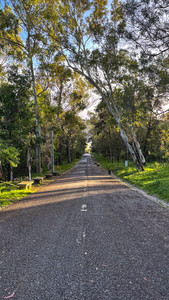


First up is the Eurasian Blue Tit. This was a species of bird that I was hoping to see during my time in Europe. It was searching for insects in a pine tree near one of the cafes in the park. These pine trees, if that’s what they actually were, had a low thick canopy and the tit was sticking to the shady parts of the branches. The sun was on a constant light switch, hiding behind rain clouds momentarily before peeking back out again. During one of the moments when the sun was out is when this Eurasian Blue Tit hopped on an illuminated branch and I got the shot.

One highlight from this outing was seeing and capturing images of my first wild parakeet. A pair of Rose-ringed Parakeets flew just above the treeline to another location in the park. After I took the photos Beth and I looked at each other and embraced in excitement. I’m sure the locals were confused by the two of us hopping up and down in elation.

We walked to one of the entrances of the park to wait for an Uber to take us back to the apartment. As we were waiting, I checked out a couple of nearby bushes and found a Great Tit trying to pull something from one of the stems. As the Uber was rolling up, I smashed the shutter release and locked in some decent shots of the bird before being called to get inside the car.
April 15
The plan for today was to explore a couple of the botanical gardens within Lisbon. The first one we checked out, and the larger of the two, was Estufa Fria and I’m not exaggerating - it was one of the most beautiful places I had ever set foot in.


We were greeted by several Indian Peafowl, more commonly known as peacocks. I saw peacocks a couple times during this trip and suspected that people had them as pets. Just before entering the greenhouse, we passed a pond with several different species of waterfowl feeding nearby. There were several Muscovy Duck feeding with some mallards, and several Egyptian Goose being harassed by the much larger domestic geese that were also present.
I’m not entirely sure what I was expecting when we decided to come to the gardens, but when you enter Estufa Fria, you’re immediately thrusted into a jungle of greenery. It felt like being transported to a different place on the continent. I took A LOT of photos of the plant life there, but there were also many bird species that flew freely in and out of the gardens. One of these species was another on my list to see while in Europe - the Eurasian Jay. Not as colourful as the Blue Jays back home, but just as curious and vocal.

One of my favourite spots within the gardens was the succulent/cactus section. We have several different species of succulents and cactus at home, and I thought they were thriving in that space, but the plants here were on a whole other level. These things were massive. The echeveria succulents were almost as long as me. Cactus grew to the height of the ceiling. One plant was sprinkled with lovely red flowers, but the gaps between grew horrific thorns that would be highly uncomfortable to be pushed into.


Just as we were leaving I spotted a Eurasian Moorhen by itself in the middle of the pond. The composition I settled on was meant to focus on the vibrant colours rather than any particular behaviour.

The last botanical garden we checked out was the Botanical Garden of Lisbon. Nearly as impressive, this one was completely outdoors with several large trees located within the park. We passed a couple of massive aloe plants near the entrance and the beauty continued on from there.


I would have another and better chance at photographing the Rose-ringed Parakeets I saw the day prior. Several of them were flying amongst the trees and were too high up to get a decent shot of, initially. Thankfully, one of them came down and was clung onto the side of the tree, almost eye-level. A sunray hit the parakeet at just the right time and that ended up being the keeper image of this species for the trip.
The Rose-ringed Parakeet wasn’t the only species of parakeet I would encounter during this outing. I created a photo of a pair of backlit parakeets making out on a branch. The light was divine and created a lovely golden rim light outlining the two birds, while also shining through the wings of the insects that were buzzing nearby. I didn’t know it at the time, thinking they were the same species of parakeet I was photographing earlier, but it turns out these were a completely unique species called Blue-crowned Parakeets.


A couple other keeper images from this adventure was a Song Thrush - very similar looking to the thrushes we have back home. Funny enough, the composition I settled on for this species looks very similar to a photo I took of a Hermit Thrush a couple years ago in Cape Breton, with a foreground element on the left and the golden light painting the rest of the scene.
The other keeper photo was of a Common-wood Pigeon. We saw many of these types of pigeons during our trip, and seemed to behave in a way that was a cross between the Rock Pigeon and Mourning Dove. We usually saw them in pairs and were a more colourful version of the rest of the local pigeons. Something I noticed about the Rock Pigeons in Portugal, aside from them looking a little greasier (no offence), was that the Rock Pigeons hung out in large flocks, and would rarely be seen walking the streets solo.

April 16
Our time in Lisbon was over, at least until we had to come back for our return flight home. We were to rent a car near the airport and head south along the western coast of the country, making our way eastward once we reached Aljezur and head to our final stop, Santa Luzia. Everything went smoothly with renting the car and getting out of the city and onto the highway. Beth crushed it as the driver - demonstrating incredible bravery as she navigated the busy and fast roads of Europe.

We made a couple stops along the way, first stopping in Sines for a quick lunch and continuing on to Aljezur from there. Once in Aljezur, I was able to get out and stretch my legs a bit, whilst doing some photography. Across the street from where we parked was a field of wildflowers, with a mix of white and red (the red flowers being poppies). There were several Barn Swallows flying low and high all over the town, picking off insects on the wing. One of those insects was almost a small white butterfly, which is actually the name of the species (Small White). Fortunately for this butterfly, it managed to stay out of the crosshairs of the incoming swallows, at least for the duration of my time there.


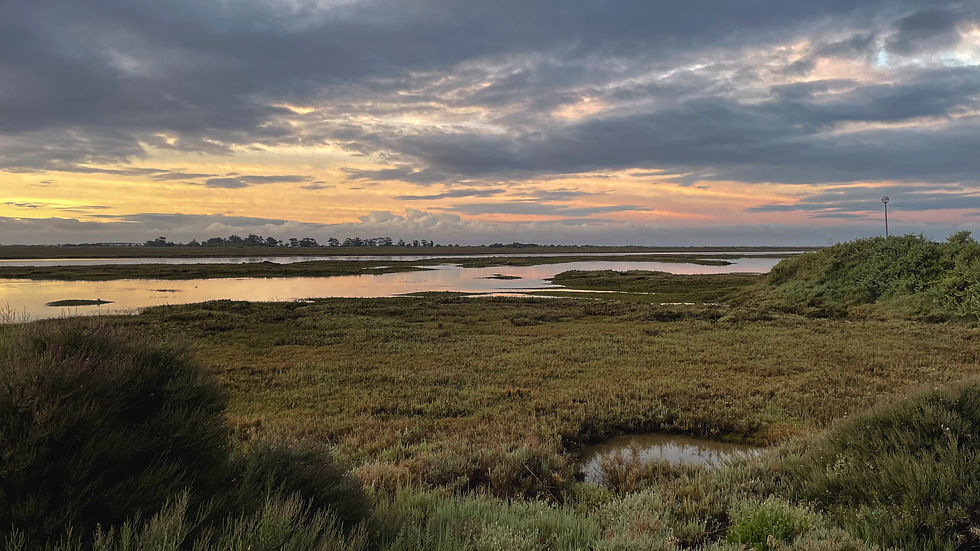
We made one more stop in Porches to check out a tile store and then it was off to Santa Luzia. As we were rolling into town, I could just feel that I was going to fall in love with this place. Santa Luzia was definitely my favourite place to be during this trip. Not only was there an air of relaxation wafting through this town, along with the smell of flowers, but it seemed like Santa Luzia was located in a bird sanctuary. Our unit wasn’t far from the waterfront, and there was a sidewalk that ran up to a bridge, which connected the mainland to the beach on the other side of the wetland.

I almost immediately went back outside as soon as we got to our new spot and with camera in hand, I got to work. One of the first things I noticed were the hundreds of Western-House Martins buzzing around our building. I tried my hand at photographing the agile birds on the fly, but I wouldn’t get any keeper images of them this day. Instead, I would get keepers of one of the other most common birds in town, the House Sparrow. I managed to get three of them on some fencing looking over the construction work nearby.


While this outing acted more as a scouting run, I did manage to get keeper shots of a couple birds in flight. First was a Whimbrel, a species I’ve only managed to get documentation shots of before in Nova Scotia, but in Santa Luzia they were plenty. The other bird was a LittleTern hovering above the shallows, moments before it took a dive to haul up some food.
Just before bed, as Beth and I were having a glass of wine on the patio, we heard a haunting call of a Tawny Owl somewhere off in the distance. It was loud enough that the Merlin was able to pick it up and confirm the species, but we never ventured out to find it. It was a pretty great way to end a pretty great day.
April 17
I was up just before dawn to get some early morning nature photography in. I would explore a lot of the same areas that I did the evening before, just with more time to do it. The sunrise was beautiful and there was the constant smell of flowers in the air. The sidewalk ran past a few orchards - lemons, oranges and avocados. On the other side of the road, the tide was low and the shorebirds were out in force. There were Common Greenshanks (very similar looking to the Greater Yellowlegs back home), Common Sandpipers (similar to Spotted Sandpipers back home), along with Great Cormorants and Common Shelducks.


If the shorebirds weren’t feeding on minnows or worms, they were most certainly feeding on the fiddler crabs. There were thousands of West African Fiddler Crabs in the wetlands between the beach and mainland. Once the tide went out the burrows began to reveal themselves. There seemed to be several territory disputes between the larger males. Though the access to the wetlands was restricted, I still managed to get low enough to get one of these confrontations on camera.
One of my favourite moments, and photos, from this outing was documenting the Little Egrets stalking their prey amongst the flats. One in particular was wading near the bridge heading to the beach. There was a bunch of commotion in the water just in front of the egret, as a school of fish thrashed about in the murky depths below. The larger fish seemed to be feeding on what the egret was interested in - these almost translucent minnows that leaped from the water to escape being gobbled up. I took several shots of the Little Egret trying to snag some of the minnows up. I liked how clear fish caught the sun as they jumped into the air, narrowly dodging being snatched in the egret’s beak.


There seemed to be even more small song birds to photograph than shorebirds. The most vocal of the bunch were the European Serins, small yellow and green birds with stubby beaks. I took several decent shots of this species, but my favourite was taken of a male singing his little heart out from some barbed wire.
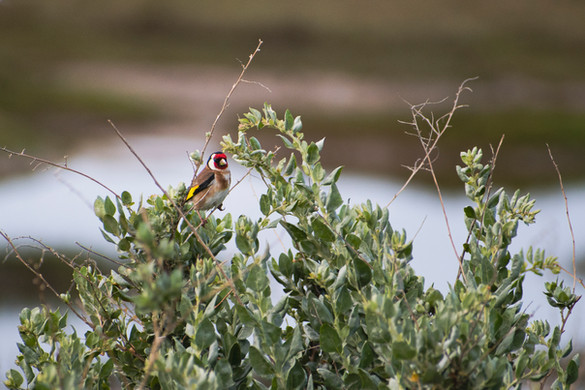
Further down the wire was a pair of European Greenfinch. I didn’t take as good of photos with this species, but I liked this shot because of the wild cactus directly behind the pair. I thought this photo highlighted the environment these small birds exist in, something completely unique to the landscape in Canada. The serins and greenfinches weren’t the only birds in the vicinity. A pair of Red-legged Partridges were feeding on the dew dropped grass next to the lemon orchard. A Eurasian Collared-Dove, one of many in the area, takes off from a fence post. And on the other side of the road: a Sardinian Warbler emerges from the bush and stares up at me with its menacing red eyes and a European Goldfinch takes a break from the fly feast in the air.


Most of the feast was celebrated by the martins and swallows in the area. It seemed that everywhere we went in Portugal, swifts, swallows and martins were there. Along with the Barn Swallows were their cousins, the European Red-rumped Swallows. I managed to photograph one preening on top of a soccer net post. The most common of these birds were the Western House-Martins. I would watch these birds perform aerial feats in the air, watch them come down and collect mud, and watch them fly back to the nests to perform renovations. Something I noticed during my time in Portugal was the seemingly symbiotic relationship these birds have with the locals. I suspect that since the birds help keep the biting insect population down, like mosquitos, the locals allow them to build their nests relatively undisturbed. I say relatively as there were a few nest sites where I found anti-nesting spikes installed, mostly around the entrances of people’s condos.


As you can probably tell the morning was highly successful, but there was one more keeper image from this day before signing off. I encountered a couple of different magpie species during this trip. The gang decided to walk from our place into Tavira, the next town over, and we took the country roads to get there. We passed several more orchards on the way, and one of them had an Iberian Magpie scanning for food on a post. I have a feeling that this was the first unique bird species I encountered in Portugal. When we first landed in Lisbon, I saw a dark, medium sized bird with a long tail flying over the airport and I think it was this species.
April 18
Beth had organized a dolphin and cave exploring tour in Portimão so we headed off late morning for an ocean adventure. On the way there, I managed to capture a pair of White Storks standing in their nest on an electrical pole. We saw many of these nests on the way south, but this one was close enough that I upped the shutter speed to 1/3200th of a second and shot away. These are massive birds, maybe the biggest bird I encountered during my trip, only comparable to the flamingos and spoonbills in size.

The boat ride was, well, it was an adventure. We took a wide speed boat, with rows of benches and cushioned seats along the sides. Beth and I sat on one of these side seats and after a brief rundown of what to expect, the captain put the motor into gear. The water was fairly rough, with 2-3 foot waves. We did not slow down for an instant during our quest to find dolphins. We would launch off waves for roughly an hour looking for dolphins, until the crew decided to head back towards shore to check out the caves. Many passengers went green in the face as we sped back towards the coast. Eventually, we would hit the limestone caves of the coast of Portimão and I would finally have the chance to take some photos. While the rocky coast wasn’t as active with birds as I was hoping, there were certainly a few species that I captured that made it to the keeper list.


Most of these birds consisted of Yellow-legged Gulls, the most common gull species we encountered during the trip. I managed to create an image of a pair of gulls sitting on one of these limestone and sandstone outcrops and was informed by the crew that the small white stones embedded into the rocks were actually fossils of seashells, hundreds of thousands of years old.

A few European Shags were resting on one of the larger ‘flowerpots’ jutting out from the ocean below. While a lot of these subjects were stationary, I used shutter speeds between 1/2500 and 1/3200th of a second to freeze the action because the boat moved so much in the water. On another, larger, ‘flowerpot’, we saw some foliage growing and several egrets roosting amongst the growth. We were told these were all Little Egrets, but after a closer look at the photos back home, I noticed that one of them was a Western Cattle-Egret, one of the species we saw during the drive south from Lisbon. I was happy I had the chance to get better shots of these guys as I wasn’t able to do anything with the shots I took while we were driving.

April 19
I wanted to try and explore all the little country side roads near our Vrbo before heading back home. Beth joined me for this outing and I’m glad she did as it ended up being as successful of a nature outing as the shoot a couple days before. The plan for the day was to try and capture as many of the bird species that I’ve seen during this trip, but hadn’t managed to take decent photos of yet.

While I was waiting for Beth to get ready, I ventured out and did a lap around the block. There was the usual racket of the early morning bird calling from Eurasian Collared-Doves, Western-House Martins, House Sparrows and Eurasian Blackbirds. There were several young gulls just outside the apartment, but I don’t know the species well enough to be able to identify what is what. Many young gulls species look incredibly similar to each other and it takes years to be able to identify specific species when they’re grouped together. I certainly struggle with this and am constantly making errors and readjusting when needed. I think one of these gulls was a Lesser Black-backed Gull, an uncommon species in Nova Scotia, but much more common in Portugal. The dark grey wings led me to believe that it was the Lesser Black-backed Gull, but am still not 100% certain.

Once Beth joined me we were off to the orchards. The birds were still highly vocal so it made it easier to pick up specific breeds with the help from the Merlin app. One of the louder and more distinct calls was coming from a Eurasian Blackcap. Eurasian Blackcaps were a fairly common sight throughout Portugal but they were skittish and quick and made for excellent practice for Nova Scotia’s warbler season. I hadn’t managed to take any decent shots of them until this point, but one finally emerged from the thick brush to give a song, and that’s when I took this image.

Walking about a path between two orchards, we heard some rustling in the bushes near the ground. There was a small dish filled with bird seed so we thought small songbirds were popping in and out of the bush to gather some. Turned out to be a couple of cute Brown Rats. I thought I saw a rat near this location the day before, but it only appeared for a flash of a second before disappearing into the orchard. It was the only wild mammal species I found during my time in Portugal. It was weird not seeing a bunch of squirrels around, but upon further research I did see that the large national park north of Lisbon is home to several different wild mammal species. I guess I’ll have to come back to head northward next time.
Not long after finding the rats did Beth and I hear a commotion coming from one of the avocado orchards north of where we currently were. We heard the twin calls coming from Little Owls and we immediately jumped into action. I had seen a Little Owl the day before resting on a powerline several hundred meters away from where I was standing. I stayed there long enough so that I could show Beth, but it was tiny in the frame and didn’t make for a great image. We were so excited to have another chance to see the Little Owls and hopefully get closer than we did the day before. There was a large bank to my right so I climbed that in order to get a better view of what was freaking the Little Owls out.
Perched in a large tree above the orchard stood a Black-winged Kite, glaring outward with its menacing red eyes. I saw this kite hunt in our area for a few days during our stay in Santa Luzia. The first time I saw the kite it had just successfully snatched up a small rodent.

I didn’t see either of the Little Owls near the kite, so I lowered myself back onto the road to link up with Beth. As we continued along the dirt road, Beth spotted a stubby silhouette perched on a pole in the middle of an avocado orchard. There, one of the Little Owls stood watching us and I only just managed to get my lens up to get a couple shots before it landed and was lost in the tall grass.


We continued on, heading in the direction of Tavira to stop at a cafe for a late breakfast snack. While I was distracted taking photos of a Wall Brown Butterfly a pair of lightly coloured birds appeared with red faces and red beaks. These birds totally caught me by surprise, but thankfully I was ready. One of them landed on a large piece of grass, with a somewhat clean background. These are some of my favourite moments when you see a new species, or a species you were targeting, and it appears out of nowhere and in a place where you can get a good shot of it. And that’s exactly what happened with these Common Waxbills.


On the way back from Tavira, just before Beth and I experimented with some landscape shots of some abandoned buildings taken with our phones, I took my last keeper image from the morning. A Common Wall Gecko clung motionless to a wall alongside the road we were on. The gecko didn’t stay long and I only managed to get a couple images of it from behind before it disappeared to the other side of the wall.


The adventures weren’t completely done for the day. After an afternoon of exploring the town of Tavira, we ventured over to the salt beds just outside the town. They didn’t look like what we were expecting them to look like, and assumed that the town had recently harvested the salt from the beds somewhat recently. That didn’t stop several different species of shorebirds from stopping by and searching for food themselves. Most of the shorebirds were out of range for my lens, but there was a large row of Pied Avocets sitting along a mud bank that I managed to get images of. I even managed to see my first wild flamingo - a Greater Flamingo - though it is small in the frame. I opted to go for a more environmental shot with the flamingo as it was giving itself a scratch with one its long stick legs.


April 20
For my last day in Portugal I wanted to spend more time photographing shorebirds in the salt beds just outside the towns of Santa Luzia and Tavira. Not long after leaving the apartment did I finally get a decent shot of a Spotless Starling belting out a toon from an antenna, and that's when I knew it was going to be a good morning.
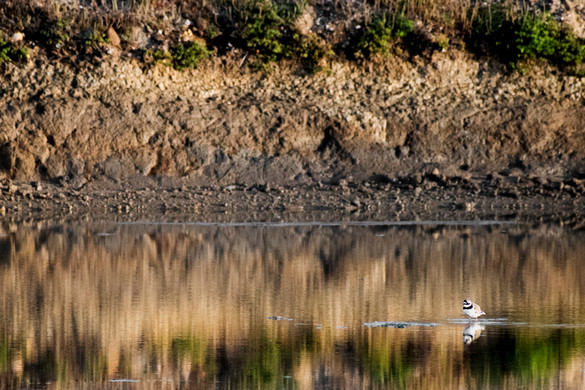
The salt beds outside Santa Luzia were still and buzzing with bird life. Hundreds of martins, swifts and swallows were darting around just above the salt beds, and each pool carried between fifty to a thousand different shorebird species. Several large groups of Common Ringed Plover mixed in with familiar Sanderlings, Ruddy Turnstones and Dunlin were present, along with Pied Avocets and Black-winged Stilts that stood out more from the crowd with their black and white plumage (and the bright red legs of the stilts).




One of the most exciting parts of this morning was watching a pair of Eurasian Hoopoes land on a small square building. These were one of the most unique looking birds I had ever seen, looking like a mix between a woodpecker and, uh, well I don’t know but something funky. They aren’t the best images, but still thought they were cool enough to select it for a final edit.

Another exciting moment was being able to get an excellent shot of a Cetti’s Warbler. I heard this warbler a couple times during my time in Santa Luzia, but hadn’t managed to get a lock on it. The Cetti’s Warbler is one of the only birds I did a bit of extra research on to figure out how to capture this elusive bird. Cetti’s Warbler sings their song from a perch then immediately duck into the dense bush before popping back out to sing again. They do this in order to hide from potential predators after drawing attention to themselves. They’ll always fly to a different spot to sing another song, so you have to keep a vigil on the whole area in case you miss the plain coloured warbler moving from spot to spot. I took what I learned about this bird and did exactly what they advised. After a few attempts of tracking the small bird with no success, it would eventually pop out on a long piece of grass to sing, and thankfully the location had a clear background making a decent final image of this skittish bird.

Another bird that was skittish that I wasn’t expecting was the Eurasian Magpies. I usually saw several out and about during each outing, but they never seemed to be in a spot where I could get a decent shot. While I was at the other end of a salt bed I watched a magpie land on top of the giant mound of salt near the entrance to the flats. The Eurasian Magpie is tiny in frame, but the composition shows the unique resting area that was the mound of salt that these birds find themselves living near.
Another bird I managed to improve shots on was the Eurasian Spoonbill. I didn’t think this was going to be the first spoonbill species I encountered, but was certainly giddy when it was. I had only managed to take doc shots of this bird before, but this one was much closer and I got some shots of it in flight, just as it passed one of the salt factories. It was cool to watch these birds search for food. They would swing their heads from side to side while in the shallows, sifting out the water and trapping prey in their spoon-like bills.

A few more smaller birds would make themselves present to me before the end of the walk. A Crested Lark was a pleasant surprise as it appeared along one the banks of the salt beds, also singing a tune. I was able to get some yellow flowers as a foreground element in this final edit. A European Stonechat was captured just as it was landing on a plant in the sun and a group of brightly coloured Eurasian Linnets took a reprieve from a line of barbed wire.


My last keeper wildlife photo from Portugal was of a Zitting Cisticola sitting in a tree just outside the apartment. I loved the purple flowers in the background and was pleased this bird came down from bustling on high. These birds had a very recognizable call, a sharp buzz each time it flapped its wings, similar to the American Goldfinches back home. It seemed rare that these guys ever came down to land so I was grateful the end such an amazing trip with one perched on a tree with a colourful background.

April 22
After a long day of full on traveling, Beth and I took off from her sister’s place to pick up our cats from Beth’s father’s home near Pictou. On the way there I would take my last nature photo of the month.
A lone Eastern Coyote was searching for food amongst a couple mounds of dirt in a farm field. Beth and I both spotted it and she immediately pulled over. I scrambled to get the camera and lens setup and stepped out of the passenger door to take a few shots. The coyote didn’t stay long and was already heading back into the woods as I was getting out of the car. It looked back a couple more times before doing so and that’s what I settled on for a final edit. It’s funny in some ways that I go from not seeing a particular species at all to now finding them monthly and (almost) reliably.

Portugal was truly an amazing trip and I wish I could better illustrate just how amazing it was - aside from showcasing the beautiful photography. The people, the nature, the wildlife - every day was something new and it took me back to the first days of my nature photography journey. I remember getting so excited to see and log every new bird species I came across and how I jumped to strategizing on how to create artistic compositions of each. I was in a constant state of child-like wonder from walking the streets of Lisbon, the palace grounds of Sintra, the coastlines of Portimão, and the natural beauty of Santa Luzia and Tavira. For my first big international trip since 2009, I’d say Portugal was easily a success. We’re already in the process of talking about another trip in the coming year, and would imagine this theme to carry on for, ideally, the rest of my days.


Comments