

Nova Scotia's Wild Side
- Matt Lucas

- Jun 13, 2024
- 36 min read
Updated: May 21, 2025
May was an exciting month, for a lot of reasons, one of those being a trip around the mainland of Nova Scotia, with the sole goal to capture Nova Scotia’s beauty in parts of the province I would have likely never explored otherwise. The trip was SPECTACULAR! This will be a longer post, longer than usual anyways as there are so many tales to tell from the trip. If you're just looking to hear about the trip, start on May 17.
Appreciate you being here and reading as always!
May 4:
Seems like all the birders caught wind of the two unique bird species that came to visit the Halifax Public Gardens near the beginning of May. Those species of birds were the Eastern Kingbird, and the Yellow-Throated Warbler.
The Eastern Kingbird was fairly easy to find. He was hanging out by the larger pond in the centre of the gardens. It was a chunkier kingbird than I’ve seen before, but that fact didn’t prevent him from performing some spectacular aerial acrobatics attempting to capture flies. This Eastern Kingbird was incredibly cooperative and really helped my training for capturing birds in flight. He even managed to make his way over to the more colourful flower beds, which made for some lovely photos.


The other bird, the Yellow-Throated Warbler, was a little trickier to find. It was about a quarter of the size of the kingbird, but I did find it eventually. I actually found him in the perfect spot. It was feeding in a forsythia bush near the edge of the park. The colours matched perfectly with the yellow of the warbler. I waited patiently for its little head to pop out in the messy bush and snapped away. It was really cool seeing one of these guys again. I saw my first a couple years ago during one of my photography classes’ photo walks in downtown Dartmouth. Oh what little I knew back then - and how rare to Nova Scotia this species can be. Definitely glad I received a second chance to photograph this amazing little fella.

It was also cool to meet up with a bunch of local birders - sharing exciting locations and helping one another out finding species around the area.
May 5:
I haven’t done a beach session in a few weeks and I was really hoping to capture some images of Red Fox kits, especially after the high from photographing foxes at Rainbow Haven a couple weeks prior. For this, I headed out to Martinique Beach in East Petpeswick.

It did not take me long to find the fox kits. I was attempting to capture a Yellow-Rumped Warbler in one of the nearby spruces when I caught the tail of a little fox cub running down the dirt road towards the boardwalk. I immediately started to ‘speed walk’ down the road after it, fully thinking that I lost the opportunity to see it again.
I kept along the road, checking over each parking area as I headed down towards the end. Not long after the first few parking lots is when I spotted the mother heading my way from the direction I was going, with what looked like a Star-Nosed Mole in her toothy maw. I hit the deck, camera at the ready, and just waited and watched as she cantered towards me. She stopped about 30 feet in front of me and veered off into the low bushes to the left (her right). I got back up and turned back to see if she would pop out from the brush to head back to the den. She did exactly that and that’s when the two fox cubs came out to see what their mother brought them for breakfast.
These guys were the sweetest (and only) fox kits I’d ever seen, up to that point. The two cubs would play-fight with each other, check out the meal their mother brought them, roll around in the dirt - classic cub stuff. That’s when I was finally able to get some snaps of them. I don’t hate how the photos turned out, but it was still fairly early in the morning with overcast, which meant my ISO was higher than I would’ve liked. Still, I always make do with the conditions I’m in.

Another highlight from this trip was seeing my first Piping Plover! These little guys are a threatened species of bird and according to Partners in Flight database, only 8,400 individuals exist in the wild (https://pif.birdconservancy.org/ACAD/Database.aspx)

I spotted it on my way back from the end of the beach. I almost didn’t as their incredibly well camouflaged for their sandy environment. It would charge out towards the water’s edge when the waves receded and quickly attempted to look for prey before the waves returned. I was fortunate to watch it perform its characteristic feeding behaviour where it would stick out one of its feet into the wet sand, churn it about, and haul out a worm almost the same size as the plover itself. I watched it do this several times, taking photos throughout the duration, and waited until it backed away to the sandbank until I attempted to move past it.
A couple of species of note from the trip are: Black Scoter, Greater Yellowlegs, and Sanderlings. I did manage to also get some cool shots of a Belted Kingfisher, but this was captured after I left the beach and was at my cottage doing some work.


May 11:

My trip around mainland Nova Scotia was fast approaching and I JUST received a cold. Not wanting to over do it, I decided to just do a quick little jaunt across the street, back to the Halifax Public Gardens (as I clearly needed my nature photography meds more than actual medicine).
This trip wasn’t as fruitful as the previous outing around the gardens, but I certainly got some cool shots. One of those being a young American Red Squirrel peeking out at me from a tiny little hole in a tree. Truly amazing how these guys are able to get themselves into spots like this. I actually noticed a couple of squirrels coming in and out from the hole, which led me to believe it was their family home.
May 12:
I had a Mother’s Day due with the family later in the morning, but just enough time to squeeze in another nature photography outing. I made my way over to Hartlen Point. A couple species to highlight are the Green-Winged Teal and Willet.

I found the pair of Green-winged teal feeding amongst the dead reeds near the cove, just before the golf course. I almost missed them at first, but somehow managed to not spook them off. I immediately lowered myself amongst the reeds and waited for a clean shot. This was the best opportunity I had to date to capture some decent images of a drake Green-Winged Teal. While my favourite image of the drake has a busier background than I would’ve preferred, at the same time I do love me some grass and wasn’t too upset about what I got.

Lastly, I captured the Willet feeding on a large rock that was about waist high from the ground. The rock was close enough to the shoreline that the waves would break against it. I waited for the Willet to get in a position where I could freeze a breaking wave as the Willet walked by. And that’s exactly what I captured. I have a few Willet photos now that I love, and this one was added to the list.
May 17:
Now we get into the trip…
My epic journey around the mainland of Nova Scotia had me start in Sable River, where I found a place to park and started down the Shelburne County Rail Trail towards the Tidney River Wilderness Area. I got there early enough that I still had a couple of hours of sunlight before it would get too dark to shoot, so I got my gear together, doused myself in bug spray and took off into the woods.

This first night out might have been the quietest of the trip, but that is not to say I didn’t find anything. The biggest highlight from this outing would’ve been the amount of Chestnut-Sided Warblers that I found. Definitely the most I’ve seen in one outing to date (Chestnut-Sided Warblers were actually very abundant throughout the trip). Even managed to get a shot of one facing me mid-leap from a branch.
During this outing I saw 15 different species of birds, most are a mixture of different warbler species and the common suspects that are present during most outings: American Crows, Black-Capped Chickadees, American Robins, Song Sparrows etc.
Did see a couple of Red-Tailed Hawks soaring together near the open wetland area not far from the beginning of the trail. Other than that, like I said, a fairly quiet evening photography session. I headed back where I set up my tent, made myself dinner, and got an early sleep as I had a longgg journey ahead of me.

May 18 (Part 1):

I was awoken suddenly by the duck quacking noise that is my alarm and I knew it was time to get a move on - no faffin’ about. Today’s adventure, at least the morning portion, would take me to Kejimkujik Seaside National Park, near Port Joli. I was very excited for this outing, in particular because of the number of Black bear sightings in the area.
I had 3 ‘big ticket’ predators I wanted to photograph during this trip: Black Bear, Eastern Coyote, and the Bobcat. Now, I will state that I did NOT find any of these predators during my outings, for better or worse. Certainly not for lack of trying, and there were plenty of signs that coyotes were around. Keji Seaside had several signs around the park warning people that there were Black Bears in the area. Maybe if I had gotten there an hour or so before dawn I may have had better luck, but that didn’t necessarily mean that I would get a photo of one. In fact, it was quite foggy when I first got up so I was pushing my ISO during the earliest part of the outing.
While the fog never fully cleared, it did nothing to dampen my spirits during the shoot. When I arrived at the park, I was instantly greeted by a Snowshoe Hare, and that was before I even got out of the car. I felt good about this place. And then came the park’s REAL gatekeeper, a Ruffed Grouse.
This grouse… oh man. I was still in the car when I saw her emerge from the small patch of bushes in the centre of the parking lot. She scared off the Snowshoe Hare and immediately made her way over to my car. I lost track of her while I was getting things together in the car and assumed she went back into the bushes.

I stepped out of the car and went to the trunk to grab a few more things and get my boots on. As I was tying my boots, the Ruffed Grouse emerged from underneath the car and started to circle around me where I was standing. It was WAY too close, but I definitely didn’t want to pick it up and put it back in the bushes. My first thought was that people were feeding her and that she was looking for food, but then she started to peck at my boots as I was tying them up. And then the pecking got a little more aggressive. She would back off for a bit, disappear under the car, and then come back out, charging towards me. That’s when I figured that her nest must be nearby, and likely in the bushes that were in the centre of the parking lot.
I didn’t want to move the car as she kept going underneath it, so I thought it best just get ready as soon as possible and head for the trail. I thought as soon as I left the parking lot the grouse would leave me alone, but I was completely wrong. She must’ve followed me for a quarter of a kilometre before she backed off into the woods just off the trail. The whole time she was following me she kept bluff charging, until I created some distance and she would just casually peck at things on the ground with the odd charge when I wasn’t looking. It was kind of funny watching her peck at something on the ground non-chantly, playing it cool-like, when I looked back at her and as soon as I started to continue on with the trail she would come at me. She soon disappeared into the woods and left me alone, at least for the time being.
I really, really liked this park. It kind of reminded me of Crystal Crescent Beach a little in that there are a few different ecosystems within the park, so you’re getting several opportunities to photograph a wide range of unique animal species. Not far from the beginning of the trail did I come upon what I call ‘warbler alley’, which were head-height thick bushes that ran along either side of the trail. Saw plenty of cool warblers, including the Yellow Warblers, Ovenbirds, Common Yellowthroats, Chestnut-Sided and Black-Throated Green Warblers. There were also a Gray Catbird (my first of the year) and Swamp Sparrows. I actually got some really nice shots of the Swamp Sparrows. Even a White-tailed Deer doe came out from the bush to say hello at one point.


A few other bird species of note from this outing were a few Northern Gannets that were flying northward aways from the coastline. Saw a couple of Common Terns, which I haven’t seen in a while so that was nice. There was also a large group of Harbour Seals (and a couple of Gray Seals) playing with one another near the beach. One Harbour Seal kept climbing on top of a rock and would purposefully (and dramatically) roll off it as his friend watched. It was kind of hilarious.

That was pretty much it for this outing, however, as I was getting back to my car the memory of the Ruffed Grouse came flooding back and the tension rose. I saw her prowling the parking lot, looking for her next victim. Unfortunately (well, fortunate for me), a young family rolled up in a van on the opposite side of where I was parked and diverted the Ruffed Grouse’s attention momentarily. As the grouse started to harass the unsuspecting family, I quickly made my way to my car and got in. The Ruffed Grouse took a brief respite on top of a rock in front of where my car was parked. From the safety of my car, I rolled down my passenger window and snagged a few shots of her before I decided to take off. And wouldn’t you know it, as soon as I start pulling out of the parking lot, this grouse starts bounding towards my car, literally chasing me out of the park. It reminded me of the scene in Jurassic Park when the T-rex is chasing some of the characters trying to escape in a jeep and the T-rex is in the side view mirror getting closer. Just like the movie, I put my car into 6th gear and booked it out of there, leaving the grouse in the dust (and hopefully in peace).
May 18 (Part 2):
The road from Keji Seaside would take me back to the 102, where I would continue southbound towards Stoney Island Beach, my next stop. I got there about mid-afternoon and took a brief nap before I decided to head off again. The fog had waned a bit at this point, but it was cloudy and VERY windy.

In hindsight, I kind of wished I had waited another couple hours before I took off for my next hike, only to be out closer to dusk, but I ended up going late in the afternoon and wrapped up earlier than I would’ve preferred. It may have been for the best as the weather took a turn and it started to rain, but still.
I took off along the beach heading towards Sable Fish Packers. I did see a few things along the way, a dead Canada Goose which looked like it was killed by a fox. Common Eiders and various gulls and a White-tailed Deer.
One awesome moment was when a couple of Turkey Vultures flew low to the ground as they were being chased by a couple crows. I made my way over to a patch of low forest that looked like it had been battered by years of blistering winds and seaspray where the vultures were circling above. One vulture in particular was right on top of the tree line providing me with my closest vulture shots to date (oh what little my ignorant self knew then).
Aside from waiting around an hour or so to see if a fox would show up, that was pretty much the conclusion of this shoot. I found a spot to pop my tent for the evening, just before the rain started to come down.
May 19 (Part 1):
Didn’t have the greatest sleep this morning and was awake by 3:30 AM in the morning. This actually worked out as the wind was so strong that it blew off the raincover to my tent. As I was already awake at that point I avoided my camera gear getting too wet as I hopped to getting the raincover back on promptly. I pretty much laid on my inflatable mattress until I judged it light enough to get an exposure.
My plan for the morning shoot was to head to The Hawk Beach, in particular to search for American Oystercatchers. I headed south of my location and parked in front of a wall of boulders just behind the beach area. It was super windy. It felt like a consistent 50 kilometre wind battering the coastline. Kind of wish I actually noted the right wind speed, but whatever it actually was, it was windy AF. At least with conditions like that I am unlikely to find other people in the area so I had the beach pretty much to myself for the better half of the morning.
I started off by heading slightly north from the beach, into the wind, and planned to head back south all the way to the point and then back to my car. This was definitely the windiest conditions I shot in so far. I ended up taking my lens hood off for better control. Didn’t see much on my way north, but heading back down along the beach towards the point I did come across three Piping Plovers, which was super exciting to see. They did not seem bothered at all by the windy conditions and were perfectly content scurrying along the beach looking for food. The wind was at my back when I was shooting the plovers so I did manage to get quite a few shots of them feeding in focus. I didn’t want to bother them too long so I got what I wanted photography-wise and continued along the beach southward.
The Hawk did provide me with a good portion of my landscape photography for the trip. There were a lot of unique looking compositions and not a lot of wildlife around so I mostly shot with my landscape lens, the 18-140 mm 3.5-5.6 Nikkor.




This is not to say that I didn’t see any more wildlife after the Piping Plovers. As I was approaching the point (what is actually the southernmost tip of Nova Scotia) I did manage to see life again. Aside from the various gull species like Herring and Great Black-Backed Gulls, I manage to come across a group of Sanderlings feeding along the beach. And beyond that it is where I found my quarry.

I spooked the first one off as I was coming around a corner point on the beach and wasn’t paying attention well enough. I was pretty gutted as I thought I lost my shot to capture the American Oystercatcher I was searching for. Seeing a group of Black-Bellied Plovers quickly raised those spirits and I managed to capture one in flight as it was making its way down the beach. Even managed to photograph a group of Sanderlings and Dunlin (my first of the year) flying together. That’s when I spotted another American Oystercatcher.
Admittedly it’s not my favourite composition, but I’ll take what I can get. As I was tracking the Dunlin and Sanderlings in flight I panned over a Great Black-Backed Gull chilling on top of a rock. Took a few snaps of that and noticed the bright orange bill of an American Oystercatcher preening itself next to the gull, but on the ground. Unfortunately, these are the best American Oystercatcher images I was able to get, but it certainly felt good finding one and being able to walk away with at least a few images.

The wind and seaspray showed no signs of relief so I packed up my telephoto lens, brought out the 18-140 mm and got to landscape shooting for the rest of the walk. My car was just doused in saltwater and I decided to stop by a nearby gas station to clean it off the windows before going to the next leg of the journey.
May 19 (Part 2):
Before I got to my next stage of the journey, a great friend recommended I check out a restaurant called Honey Bees just outside Yarmouth, so I popped in there for some lunch. I had a craving for sushi so I got myself the spicy salmon roll, along with the lobster roll (when in Rome, or Yarmouth rather). It was sooo freakin’ tasty. Especially the lobster roll and I’m not saying that because lobster is my favourite all time food either. Staff was super friendly and quick to serve. Highly recommend checking out Honey Bees if you’re ever in the area.
After sushi it was onto Brier Island. I pretty much stayed on the 101 all the way to Digby where I eventually got onto the 217 which would take me all the way to the island, with a couple of quick ferry rides in between. Luckily, I timed it in a way that I wasn’t waiting too long for the ferries, but they run fairly often so it was never really an issue. Even got to watch a young Herring Gull go after the sculpin that was halfway down a Double-Crested Cormorant's gullet.


I arrived on Brier Island late afternoon and drove all the way down to Brier Island Lighthouse. There were a lot of Herring Gulls around, the most I’ve ever seen concentrated in a single area. I was clearly stepping into a Herring Gull nesting area. Spoiler alert, I did not get pooped on by any bird at any point during my trip around Nova Scotia. Can’t say the same for my car though…
I didn’t take much of a break when I arrived on the island and immediately headed off onto one of the trails. Brier Island was one of the spots I was looking forward to exploring the most during this trip as it seemed like such a hotspot for different bird species.

Manoeuvring my way around the Herring Gulls was tricky as I did not want to disturb their nesting sites. I did manage to walk past without too much trouble and found myself in some open grass area with the cliffs to my right and forest area on my left. I continued along the trail until I came upon what I thought were a group of young Bald Eagles. I spooked a couple of them off, and a few flew down to the seaweed covered rocks below the cliff, but one remained in place near the edge of the cliff. These were no eagles, but Turkey Vultures.
Freaking out a bit (a lot) I lowered myself slowly and snapped away. I have been trying to figure out how I was going to be able to capture Turkey Vulture on the ground or in trees, rather than photographing them soaring in the sky, for a long time now. I was thinking I would need to track one of the soaring ones and essentially watch it until it returned to its roosting site. Probably not the most practical way of doing that, but stumbling upon a group along the cliff edge on a small island off the coast of Nova Scotia works too.

The Turkey Vultures were definitely the highlight from this outing, but I did manage to spot a Merlin on top of a tree scanning for prey. I waited a bit to see if it would do anything and to my surprise, it took off from the tree in my direction and chased something off into the bushes near the beach area I happened to be at at the time.
I returned to my car via a side road, instead of walking back through the Herring Gull colony. I did manage to find a few different warbler species like Black-Throated Greens, Yellow-Rumped, and of course Yellow Warblers. It didn’t take too long to return to the car from that point. Made myself a quick supper, took some shots of the lighthouse during the sunset, and passed out in my car as I was importing photos into my Lightroom catalogue. Thankfully, the import finished while I still had battery power, thanks to my Jackery power station (life-saver).

May 20 (Part 1):
Woke up this morning just before 5 AM in a panic, with my laptop on my lap (go figure) and a drained power bank. Shoutout to the American Woodcock that landed right beside the car to provide an alternative alarm. Also appreciate the American Woodcock’s amazing camouflage as I still couldn’t find it to take a super noisy picture, even though it had to be within 10 feet of the car, belting its little heart out.
After checking that all the photos were saved and backed up properly, I gathered my things and slowly made my way along the coast to another trail heading north east. It was another foggy morning and the Herring Gulls were surprisingly quiet, relatively speaking. This was also the case with the next trail.

Things didn’t start to pick up again until after I got back to my car. There were a few American Goldfinches hanging out in the trees near where I was and I managed to get some great shots of them just doing their finch-y things. I started to wrap up about mid-morning and made for the drive back towards Digby. I passed another Turkey Vulture resting in a tree near a farm to my left, and on the other side was the next new species to log for the trip.
Just hanging out on some power lines was this beautiful Broad-Winged Hawk. It was facing away from me when I first found it and pulled up in my car a bit so I could try and sneak around to get a better angle. Fortunately, the hawk didn’t seem that bothered by my presence and I managed to capture it from several different angles, though admittedly I like that shot of it post-poop with its tail feathers up in the air. I found out later that there is quite a large population of Broad-Winged Hawks that appear on Brier Island, and that they’ve been observed soaring in circles in large groups which are called “kettles”.

I wanted to make one more stop before I reached my next nature shooting location. I had a mad craving for clams, and I was driving past Digby anyway, so why not stop in. I went to The Crow’s Nest in downtown Digby and it was sublime, especially after a few days in the fog and drizzle. It was bright blue skies out in Digby and I got myself a seat on the patio, big plate of clams, and a nice cool, icey beer to wash it all down. Like I said, sublime.
May 20 (Part 2)
I arrived at my next location near Gaspereau Mountain and was immediately excited about the seemingly endless landscape compositions surrounding me. Open forests and vast fields of GRASS, what more could I possibly ask for?
Started off along the trail and it did not take long for the birds to come a callin’. Ovenbirds and Black-Throated Green Warblers were fairly common, but one treat I came upon was a Black-Throated Blue Warbler. I heard it singing near a split in the trail where I had to decide left or right to continue on. In these scenarios I always wait to hear if I can hear a bird song, or some kind of wild activity to help decide which direction to take. In this case, the Black-Throated Blue Warbler was singing off to the right and that’s exactly the direction I went.

I’ve captured Black-Throated Blue Warblers before, but only doc shots. I found the tree it was singing in, and it was eye level, so all I had to do was wait for it to get into an open(ish) area and snap away.
I was reading reviews of the Wolfville Watershed Nature Preserve while planning my excursion. The reviews weren’t great, but some of the photos I was looking at from the area were absolutely stunning so I decided to go anyway. I came upon what looked like a collapse bridge at one point, just above a small waterfall. The light was serving at this time so I brought the landscape lens and had a field day shooting nature scenes in the area.


Last wildlife photo highlight from the Gaspereau Mountains was seeing a Yellow-Bellied Sapsucker. I actually came across a couple during the hike, but it wasn’t until I left the forest to capture the setting sun across the grassy fields that I found one I could get a clean shot of.


Lastly, I did hear two new species of bird that I picked up on the Merlin app. One was called a Veery, similar to Hermit Thrush, and just before bed, I heard a Great-Horned Owl calling. Pretty. Dang. Cool.
May 21 (Part 1):
I was pretty much excited for all the locations I shot in during this trip, but this next spot is somewhere I’ve been wanting to go for a long time and have seen so many great photos from birders in this area.
I took off about 30 minutes before dawn, avoided hitting a cute family of Red Fox (too dark and too quick to take photos of), and headed towards Miner’s Marsh in Kentville.
Miner’s Marsh was fantastic, maybe too fantastic as I stayed there an extra hour than I had planned for the day. As soon as I got there I heard a couple of Raccoons squawking at one another in a tree, but unfortunately I didn’t see them to get a shot off. There were Muskrats, Northern Cardinals, Canada Goose with their goslings and plenty of other bird species in the area. I was even informed of a Barred Owl and her owlets that were observed the day before in a tree, but alas, another subject that eluded me. I even managed to come across a pair of Baltimore Orioles (a new species for me), but only took doc shots.
A few other species of note that I did actually manage to get decent photos of were: Yellow Warblers, Tree Swallows feeding and returning to the multitude of birdhouses in the marsh, Gray Catbirds and even a couple of Eastern Gray Squirrels posed briefly for the camera.


Hard to forget the Red-Winged Blackbirds that were prevalent in the area. I logged around 20 in total, but the number is probably much higher than that. While I did manage to take all kinds of shots of the Red-Winged Blackbirds, and I did take a couple where you could see the morning breath in the cool air. There were plenty of other birds to note from this trip, but for now, let’s move onto the second part of the morning trip, which was a 15 minute walk over to the Kentville Bird Sanctuary.

Right from the start did I come upon a couple of great photo opportunities to improve and log new birds. Firstly, a Northern Flicker was feeding on the ground and seemed to tolerate my presence more than most Northern Flickers. I think I managed to get my best shots of them yet.

Also came across a White-Tailed Deer doe feeding along the riverside, with several Yellow Warblers and Northern Cardinals singing nearby. One song that I wasn’t familiar with, and that Merlin pointed out, was the song of a Rose-Breasted Grosbeak. I must’ve spent close to an hour in this particular area waiting for this gd grosbeak to reveal itself for a shot. This moment, along with another further in the park, were the only times I would come across this bird on THIS particular day.
All the most common warblers were in the area, but this was the hottest day of the trip and the light was pretty harsh at this point, so anything I caught was particularly usable. I did find a Blue Jay under the canopy of a fir tree scratching away so - shot shot cherry.


There were also plenty of Eastern Chipmunks in the area and I managed to get some decent shots of those too. Along with a butt load of other bird species, I found a Belted Kingfisher diving for food from a tree just off one of the ponds located near the centre of the sanctuary. I watched him for a bit, then noticed a couple of Eastern Kingbirds catching flies near a pond beside the one I was at. When I started towards their position is when I found all kinds of Eastern Painted Turtles chilling along the pond’s edge. Most of the turtles booked it into the water any time I got near, but I did manage to get one resting on top of a log that I was pretty happy about.

May 21 (Part 2):

The voyage from Kentville to Maccan was when I really started to try and take the old highways to my destinations. Seeing the different countrysides of Nova Scotia this way was truly spectacular. I kept to the 236 all the way to Truro, and from Truro I was on the 104 until I reach the #2, and from there northward to Maccan.
The morning shoot turned into a mid-afternoon shoot in Kentville, and I was pretty drained from walking in the heat. But as soon as I drove past the massive wetland areas of Maccan I knew I had to get out again for some evening photography.
There was plenty of bird activity, including some American Wigeons, Tree Swallows and Red-Winged Blackbirds, but I found myself focusing on other subjects. There were a lot of opportunities to capture some minimalistic landscape photography, especially with the utility poles that ran through the wetlands.


There was also a voracious American Mink that was hunting the marshes on either side of the road. I would attempt to capture a few shots of it weaving in and out of the thick reeds looking for prey, then watch it cross the road and repeat the process. I lost it at some point and backtracked a bit to an ATV trail I found just off the highway. Just as I was stepping down into the ditch to hit the trail, I heard the rustling of the mink and it was heading straight for me. This mink had to be within a couple feet of me, just running past me without notice, on its never ending quest for food. I debated on trying to scare it off before it reached me so it wouldn’t get so close, but I ended up lowering myself ever so slowly, froze in place and calmly watched it approach and pass on through. SO FREAKIN’ COOL.


Last wildlife surprise was watching a few Beaver munching away on some grass in one of the larger marshy areas. The grass made it difficult to get a clear shot, but I did manage to get a few workable images. The beavers seemed to be highly active in the area as I saw plenty of beaver poo and tracks along the trail. When one of them smacked its tail on the water warning the others in the area that I was around, I took it as my cue to head back to my campsite for the night.
One last awesome nature moment happened before I got to bed. Well, I was actually in my sleeping bag at this point when I started hearing the call of an American Woodcock. It sounded super close and I was determined to get a shot of it this time. I didn’t even put my sneakers back on thinking it would be too noisy. I stepped out from the tent in my socked feet, crouched down behind my car to obscure my form from the bird, and ever so slowly raised my camera to the roof of my car. It was pretty dark at this point so I was shooting around a 15th to an 8th of a second to try and get a decent exposure that was blasted with graininess. Pretty happy with the results and I would argue that I managed to get a sharp image of the American Woodcock considering the shutter speeds I was shooting at the time.

May 22 (Part 1):
It was a quick drive from where I was staying to my next location, the Amherst Point Migratory Bird Sanctuary. This was definitely a bird focused shoot, though I did try an attempt to improve my Muskrat photos, with little success.

I observed 36 different species of bird, with roughly 160 individuals, give or take. Most of these were Canada Goose and their goslings. One pair had to have over 20 goslings in tow. I even watched a Red-Winged Blackbird dive bomb a pair of Canada Goose and their goslings as they came too close to the blackbird’s nest, presumably. Even the fish were plentiful. I am not 100% on the species, but I thought they might have been alewives (gaspereau) just based on the sheer number of them, but a large portion of them seemed to have a reddish colouring on their pectoral, pelvic and anal fins, which led me to also think they may be a species of trout like brook or lake. I guess I should’ve brought my fishing rod out to confirm.
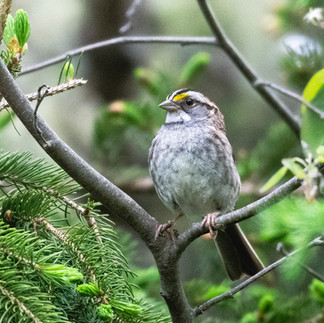
Other birds of note were several different species of warblers, including Northern Parula, Magnolia Warblers, and Black-and-White Warblers. A pair of Bald Eagle ontop of a powerline post, and a lot of different species of waterfowl in the area too, like Ring-Necked Duck, Wood Duck, a Surf Scoter, a few Gadwall and a couple new species for me: a Blue-Winged Teal and a Northern Shoveler. Both new species were located in the middle of the large ponds so all I managed to take were doc shots. Still, pretty awesome to find. There was even a friendly White-Throated Sparrow that popped out to say hello.




One of my favourite shots from the morning was from a Black-and-White Warbler preening itself. It was still early in the morning, and the light was low, meaning I was shooting at lower shutter speeds. I shot this particular exposure at 1/160 and managed to get part of his head sharp, but just enough motion blur to highlight the quick movement of the warbler scratching himself with his foot.

May 22 (Part 2):
It was off to more countryside roads from Amherst Point. From there I took the 104 to #4, then the 246, then 256, then Durham Road back to the 104 going towards Antigonish, specifically Beaver Mountain. I reached Beaver Mountain Provincial Park just after lunch and decided on a longer break between shoots as it would be some time before the light became good enough to shoot in.
This was another open woods shoot, meaning there was a lot of space between the trees and it provided a lot of opportunities to create some space between the foreground, subject and background. I got to test this out with one of the first subjects of the day, a Blue-Headed Vireo. All the images I had of these guys before were just doc shots, but the ones I took from this outing are some of my favourites from the whole trip.

At one point I came across what I call ‘Chipmunk Lane’. I was attempting to photograph a species of shrew amongst some dead logs (to no avail) and I started to hear the loud and familiar chirping of an Eastern Chipmunk. This lasted for about a half a kilometre as I continued along the trail. After each 10 or so feet, a new chipmunk chirp would sound, and eventually they would all chime in to give their opinion. Might have been the loudest point of the trip.
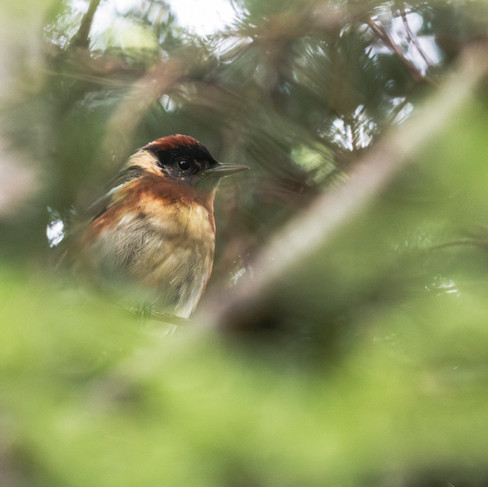
Again, so many different species of warblers, at least 11. Took some of my favourite Overbird shots of the year, weaved in and out of these smaller spruce trees to try and get shots of Black-Throated Green Warblers, even logged 3 new species of warbler for myself: the Northern Waterthrush, Blackburnian Warbler, and a Bay-Breasted Warbler that I manage to get a decent shot of framed nicely amongst some spruce tree branches.


Just before finishing the hike, I found an ATV trail that veered off into a couple of open fields (near where I found the Black-Throated Green Warblers). The colours in the sky at this time were gorgeous. My intent was to wait and see if an Eastern Coyote would pop out for an early evening hunt just as the sun was going down. There were certainly signs that coyotes were about, but unfortunately I couldn’t find any.


When I arrived back at the campsite and finished setting up my tent, I was happily greeted by a couple of Ruby-Throated Hummingbirds (my first of the year), and shortly after that another American Woodcock started flying around belting its notorious calls. Perfect way to end a perfect day.
May 23 (Part 1):
After a great night's sleep it was off to Keppoch Mountain for some more forest photography. Now this place was a pleasant surprise. The trails were super well maintained, easily marked, and chock full of wildlife. I logged 37 species of birds, 16 of which were warbler species. 3 new species were logged, all of them being warblers: the Cape-May Warbler, Wilson’s Warbler and Blackpoll Warbler.

Started off the day by hiking directly up the Money Shot trail, which was a straight shot up the mountain, but quite steep. I think the total elevation was around 200 metres over a kilometre. It was recommended that you walk down the hill instead of up, but that’s not what I did. Once I reached the summit I was treated to a spectacular view of the small mountains and low fog painted beautifully with the dawn light of the morning.
I serpentined my way back down, taking various trails along the way. Several bird species were observed, like Yellow-Bellied Sapsuckers and more Least Flycatchers, and a female Rose-Breasted Grosbeak (didn’t know it at the time). This is where I captured my favourite Least Flycatcher photos of the trip.

I eventually made my way over to the White Rock Loop trail. This trail just kept getting better and better. After passing some disc golf baskets, I heard a warbler call I hadn’t heard before. Whipped out the Merlin app and discovered that the song was coming from a Wilson’s Warbler. I found it, but it was hopping amongst the dense foliage that it was terribly difficult to get a sharp shot in. It did pop out a couple times and managed to get a couple images I liked, but this was a tricky bugger to pin down.

Well pleased with that experience I continued on, coming across more warblers like the Blackpoll Warbler, American Redstarts, Bay-Breasted Warblers, and even found a Bald Eagle chilling on one of the taller dead trees in the area. There was even a Great-Horned Owl calling, (surprisingly heard during mid-morning) followed by the squawks of Common Grackle, probably pestering the poor owl in their territory. The Ohio River was off to my right and I would periodically creep out from the forest to see if I could see any action along the riverside. There seemed to be a few large trout species heading up the river (appeared to be Brown Trout to me), again, kicking myself for not bringing my fishing rod along.

Something about this whole trip I found was that I was given several opportunities to capture wildlife species that I missed out on on previous days during the trip. The American Woodcock is one example, the Black-Throated Green Warbler, and at this moment a Rose-Breasted Grosbeak. I was ecstatic when I saw a male in the open, singing away, and staying in place long enough that I took a bazillion shots of it. A couple more Rose-Breasted Grosbeaks showed up in a hurry and the three of them were squabbling amongst the trees before flying off.

Another bird that I wasn’t able to get photos of, but witnessed on previous outings, was the Blackburnian Warbler. The ones I had seen previously were wayyy up in the treetops singing briefly before scampering off. This time, a pair were buzzing around the lower branches of the tree. I am kicking myself for not properly setting up one particular composition where the male Blackburnian Warbler was hanging upside down from a branch and the female was on a branch just under him, both staring at each other lovingly. I did get a few shots of the moment, but I cut off the lower portion of the female so only the top half of her body was in the photo. The image was also very busy with gnarly branches so it would’ve been a messier image overall regardless. Luckily, I got opportunities not long after to photograph both warblers individually in more open areas. Love the orange colouring on these guys.


I managed to make it to the end of the trail, whipped out my landscape lens to capture the white rock cliffside along the river’s edge and started to make my way back to the car. At one point I veered off the trail to get back onto the main road to the parking lot, hoping to get some decent images of the yellow dandelions in the open fields near where I was. There was a house nearby with a bird feeder near the road, and wouldn’t you know it, another Rose-Breasted Grosbeak was there feeding with some Purple Finches. This moment was interrupted by a couple of larger dogs that were off leash from their respective homes and they came barreling towards me, barking all the way. It was all good as I don’t have a fear of dogs and they were more bark than bite anyway. Plus, I had a lovely conversation with a lady, who was watching me take photos of the birds from her feeder, about cameras and lenses as she tried to calm her dog down.
Surviving an unexpected gravel road during the drive, I eventually made it to my next stop, Little Dover, near Canso. I asked this cute girl I knew about some local restaurants nearby, as she was from that area, and your boi headed off in search of some grub. I arrived at AJ’s Dining Room and Lounge around lunch time and was greeted by a friendly waitress. The restaurant was definitely divey, but that didn't bother me none, and the food was pretty good. I had a chicken poutine, I was craving something greasy for a change.
May 23 (Part 2):
I arrived at Black Duck Cove Provincial Park early afternoon and the heavy fog stayed with me for most of this outing. They were forecasting thunder showers in the evening so I wanted to do my best to avoid being stuck out in that. I took a longer break after finding a spot to park and waited until 5ish to start the trail.

The trail in this park ran through a low, coastal forest, with the rocky shoreline never too far from where I was walking. As I mentioned, the fog was very thick at this point, thus making it difficult to find the wildlife subjects I was in search of.
I was walking along a portion of the trail near the coastline when a huge Great-Blue Heron appeared out of nowhere and perched itself on a small rock. I managed to get photos of it both landing and taking off - so majestic these birds are. Not long after the heron took off did a small group of Common Terns appear, diving into the water to catch minnows. One Common Tern in particular was highly cooperative and I took several shots of it just hitting the water, and splashing around as it attempted to take off from water.


There were a few other species of note during this hike. For one, I came across a couple of Boreal Chickadees feeding with some warblers nearby, and you know I like my Boreal Chickadees. Not long after that is when the Merlin app picked up the call of a Swainson’s Thrush, another first for me. Fortunately, the thrush hopped out from the woods and landed near where the treeline met the shoreline. I lowered myself and snapped away, well happy that I logged another new species. This wouldn’t be the last new species logged during this outing however.

Near the end of the trail I doubled back a bit as I still had plenty of daylight to work with (a foggy daylight, but light nonetheless). I thought I had caught a glimpse of this bird during the start of the hike, but it flew right by me and I wasn’t 100% certain of what it was at the time. This time though, I found the Pine Siskin preening itself while periodically searching for bugs on a thin branch. The Pine Siskin is another bird I had been wanting to see for a while and was more than happy to log it as my second last new species of the whole trip, coming in at #15.

I decided to sleep in the car this night to avoid any heavy rain and potential strikes from lighting that night. It wasn’t a great sleep, though I was awake for when the thunder and lightning started happening, prompting me to whip out my phone and record some video of the flashes in the night.
May 24 (Part 1):
Slept in a little later than usual this morning, and when I say slept in I mean woke up at 5 instead of 4:30 AM. It was a quick drive to the next location, the Chapel Gully Trail in Canso. It was still rainy when I got there, but was ultimately thankful for it as a) it cleaned all the grime off my car, and b) because I wanted to get some images of wildlife in the rain.

Most of the regular suspects were present during this outing. Found both Ruffed and Spruce Grouse, more Boreal Chickadees and several warbler species, including a Nashville Warbler, which would be my last new species logged during the trip, however I only heard it and didn’t come up with any images to show for it (sad face).
One of my favourite images from the shoot was of a Spotted Sandpiper hanging out along the jagged, rocky shoreline near the southernmost point of the trail. It, along with two buddies, were simply gazing out at the ocean as the sun just started breaking through the clouds, harshly. I braved the jagged rocks myself, using some of them in the foreground to draw the attention towards the subject. Not only did I get the shot, but the harshness of the light at the time gave the photo a ‘high-key’ vibe, which I absolutely loved.

May 24 (Part 2):
Now, the original plan for the trip was to be out for another night, finding somewhere to camp near Liscomb Mills and exploring both the Mayflower Trail and the Liscomb River Loop. North of the Liscomb River Loop is where I had planned to camp overnight, but after reading the reviews of the trail online I discovered that half of the trail was closed due to the heavy water damage from last year’s rain, thus cutting off access to my campsite. To be perfectly frank, I was looking forward to getting home anyway and needed to ensure all the photos were imported correctly and no SD cards or hardvdrives were damaged in any way. So I made the call to pop down and at least do the Mayflower Trail and make my way back to Halifax from there.
Surviving another gravel road heading southwest from Canso, I plotted my way towards Liscomb Mills as the sun continued to break up the cloud cover. I arrived at the hike location late morning and got out of the car to have a stretch and walk about to get a lay of the land (and also do a couple casts into the Liscomb River just for funsies). This particular shoot was going to be dense, mostly wet forest, but a forest environment I am very familiar with as it was exactly like the forests near my cottage in Oyster Pond.
It wasn’t a long hike, but it was a bit of a slog to get through and I didn't see much for the first half. This all changed fairly rapidly as I heard a commotion across the river. Circling above was an Osprey and I noticed that it kept swooping in on a massive dead tree near the water’s edge. That’s when I spotted a Bald Eagle perched and screeching back out at the Osprey as the Osprey kept dive bombing the eagle. I managed to get a few shots of the action, just as the Osprey had its talons reaching towards the eagle’s head. As I was watching the action, I noticed another bird of prey come into view, soaring within view of my telephoto lens. It was a Broad-Winged Hawk, but it wisely chose to veer off as we both continued to watch the Osprey and Bald Eagle go at it.


Last highlight of the hike was getting a shot of a Magnolia Warbler out in the open. I saw many Magnolia Warblers throughout the trip, but most were way up in the tree canopy, or just teased me with brief moments of eye level greetings, only to bugger off the moment I raised my lens. The shot I managed to get of this one is sooo dreamy, and the warbler has such a lovely twinkle in its eye.

I knew this was going to be a longgg blog, and if you made it this far may the gods bless you and all your future descendants. This might be the longest piece of writing I’ve ever written and was not expecting it to be as long as it was. I just had so many amazing stories from the trip and felt compelled to share them, and there may even be some I left out by accident.
Part of me feels like I’m leaving a lot of specific wildlife species out from the overall tales of the hikes. For example, almost every location I visited had a Snowshoe Hare appear from the brush, a lucky charm almost. I mostly wanted to highlight the best of the photography I managed to capture, looking for specific species and improving seasonals shots of each as I found them. During the trip I visited 15 different locations, walked 114 kilometres, drove 1,697 kilometres, and logged 16 new species of bird.
Like my trip around Newfoundland last fall, this trip changed me in ways I will never truly be able to appreciate. Having my love of the wild blended in with the relatively new love of photography has truly been transformative, and at times I barely recognize the person I was before I got into it. The confidence I gain in myself from these trips, something I’ve always yearned to have a true sense of, it's almost unbelievable. I cannot (and will not) get over just how beneficial being out in nature, capturing beautiful moments, and being able to share the stories has helped me. And to think, this is really only the beginning.


Comments